
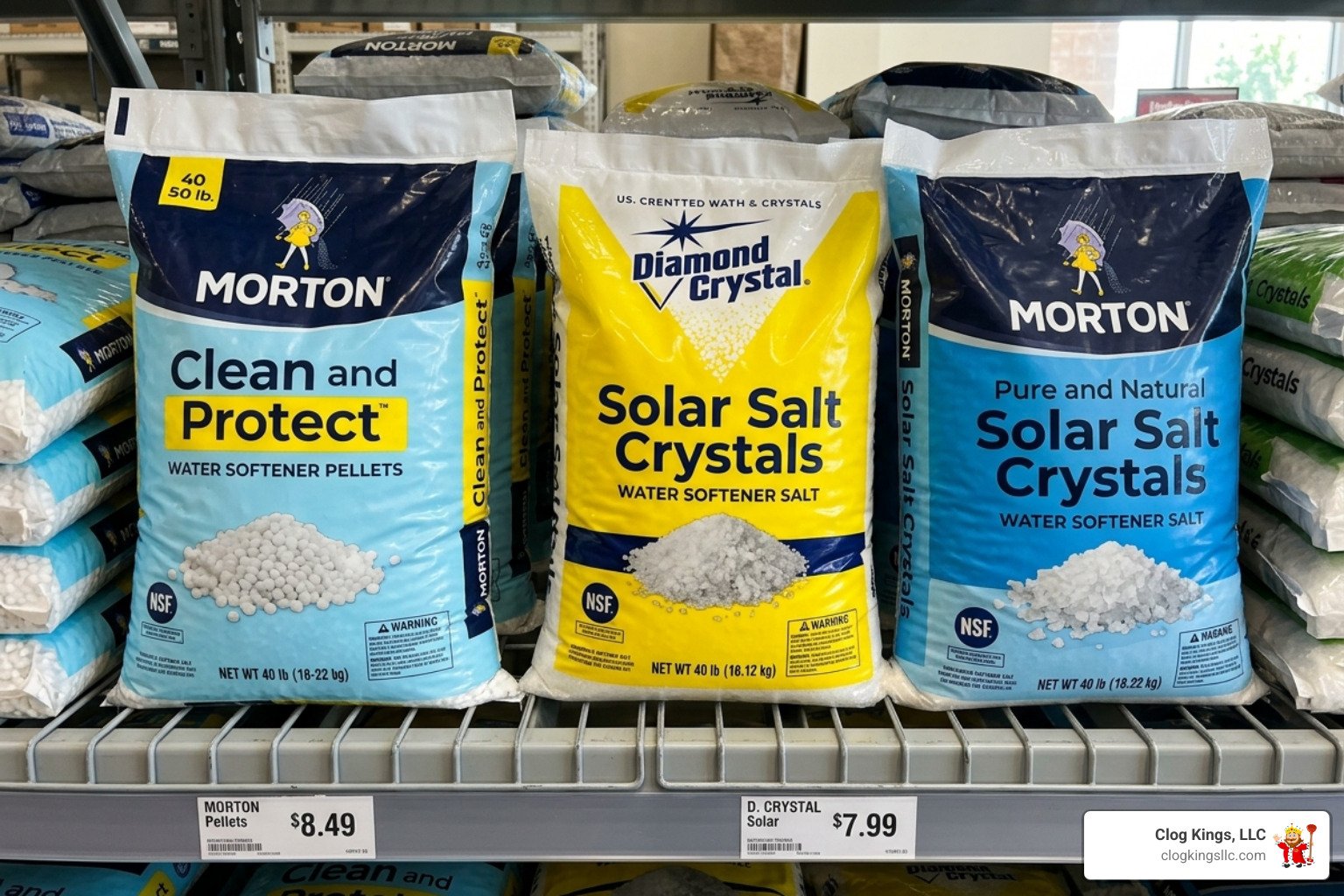

Comparing Salt Types: Pellets, Crystals, and Blocks
Hard water is a common struggle for homeowners across Florida. From the mineral-heavy aquifers in Tampa to the coastal wells of Pinellas, choosing the best water softener salt is your first line of defense against scale buildup, dry skin, and failing appliances. Understanding how ion exchange works—and why the shape and purity of your salt matter—can save you hundreds in plumbing repairs. When your system has the right fuel, it efficiently swaps hardness minerals like calcium and magnesium for sodium or potassium ions, keeping your pipes clear and your water soft.
When you are standing in the hardware store aisle staring at a wall of blue, yellow, and green bags, it’s easy to feel overwhelmed. Not all salt is created equal, and the form it takes—pellets, crystals, or blocks—matters just as much as the brand name.
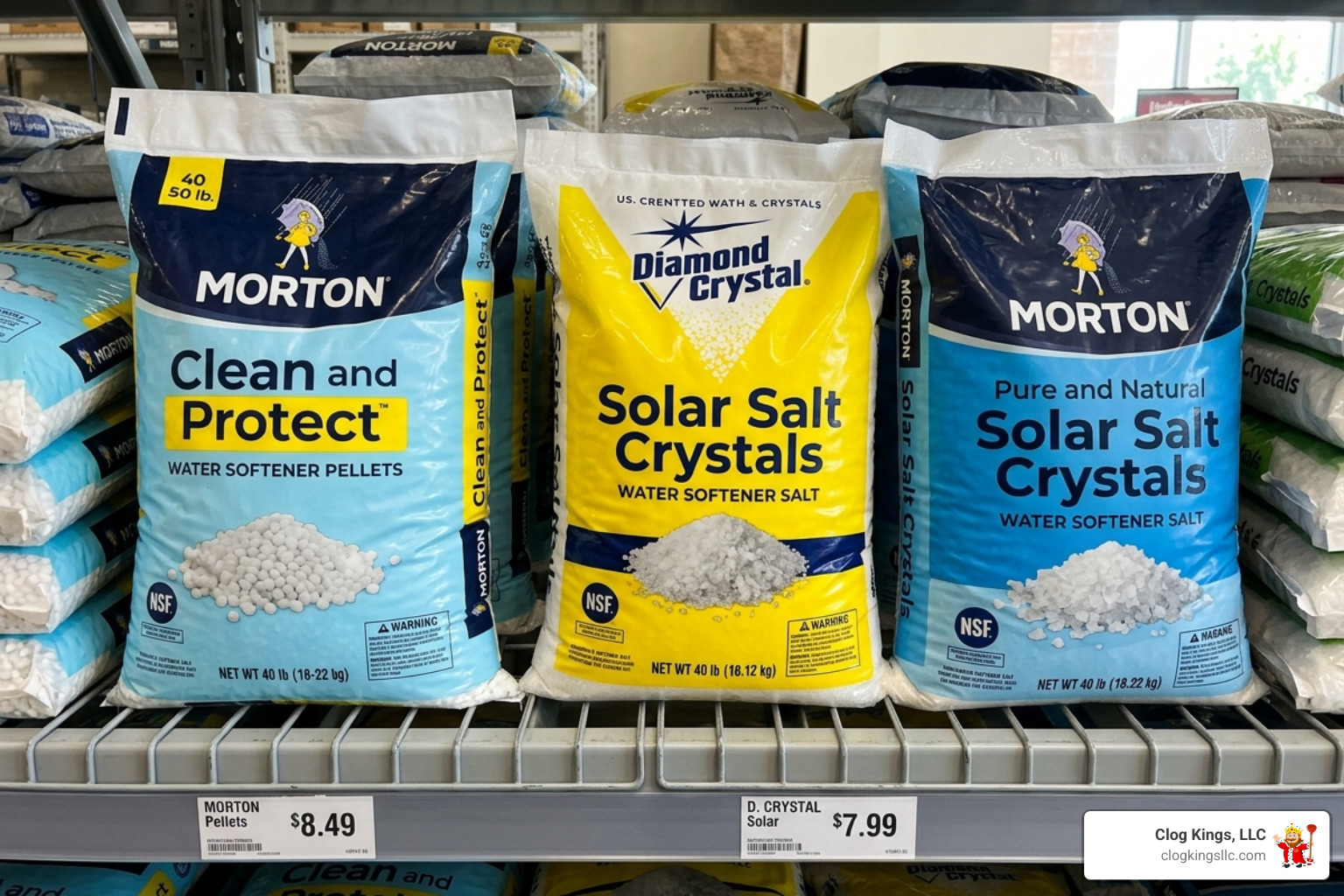
Evaporated Salt Pellets
This is the gold standard for most homes in Pasco and Pinellas Counties. Evaporated salt is created by mining salt deposits underground, dissolving them into a brine, and then using heat to evaporate the moisture. This process creates a product with a purity level of 99.8% or higher.
Because it is so pure, it leaves almost no residue in your brine tank. This high purity level also significantly reduces the risk of “salt bridging,” where a hard crust forms and prevents the brine from reaching the water. If you want to minimize maintenance and ensure your system lasts its full 10–15 year lifespan, evaporated pellets like Diamond Crystal Bright & Soft are your best bet.
Solar Salt Crystals
Solar salt is a more natural option, produced by evaporating seawater using the Florida sun and wind. It typically comes in “crystal” form rather than uniform pellets. While it boasts a high purity level (around 99.6%), it is slightly less soluble than evaporated salt. We find it works great for households with moderate water hardness, but the irregular shapes can sometimes lead to uneven dissolution. It may lead to more frequent cleaning if your water is exceptionally “rocky” or if you have a high-demand household.
Potassium Chloride
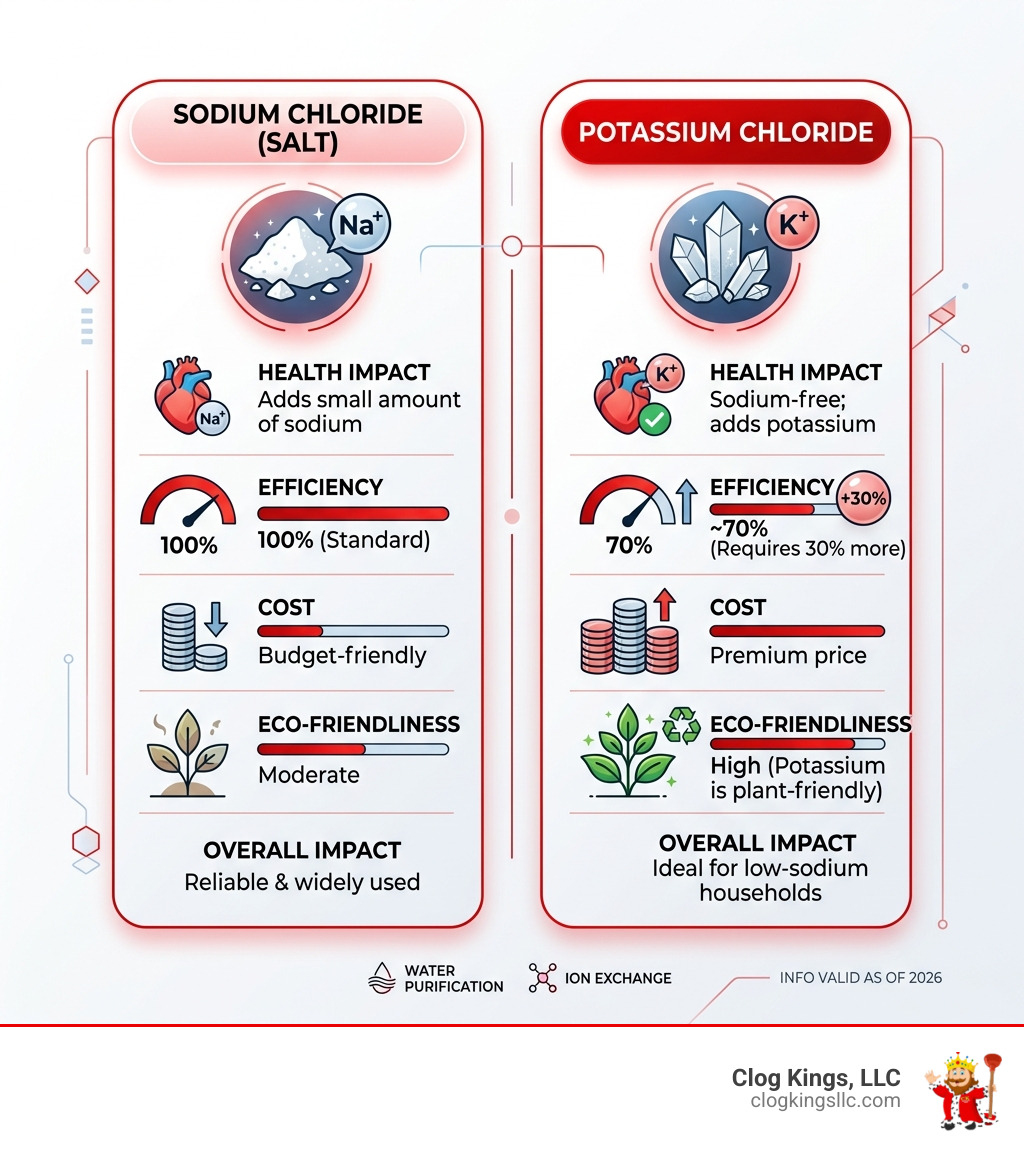
If you are on a strictly low-sodium diet or are concerned about the environmental impact of sodium discharge, potassium chloride is the primary alternative. However, there is a trade-off: it is approximately 30% less efficient at regenerating your resin beads than sodium chloride. This means you will need to set your softener to regenerate more frequently or use more product per cycle. It is also significantly more expensive—sometimes four to five times the price of standard salt.
Block Salt
Salt blocks are exactly what they sound like—large bricks of salt. While some older “post-fill” softeners use them, we generally advise against them for modern systems. They have less surface area than pellets, which can lead to a “weak” brine that doesn’t fully recharge your system. Without a strong brine, the ion exchange process fails, leaving you with hard water even though the tank looks full.
For more detailed guidance on keeping your system in top shape, check out this Scientific research on water softener maintenance.
Why You Should Avoid Rock Salt and Table Salt
It might be tempting to grab the cheapest bag of rock salt or use a box of table salt in a pinch, but please, for the sake of your plumbing, don’t do it!
Rock salt is mined directly from the earth and contains high amounts of dirt, minerals, and insoluble matter. As it dissolves, that “gunk” settles at the bottom of your brine tank, forming a thick sludge that can clog your injector and ruin the valve. Table salt is even worse; it contains anti-caking agents and iodine that can chemically damage the resin beads. Using these “budget” options often leads to a service call that costs way more than the money you saved on salt. In the long run, investing in high-quality salt is the most cost-effective way to manage your home’s plumbing health.
Factors to Consider When Selecting the Best Water Softener Salt
Choosing the best water softener salt isn’t just about purity; it’s about matching the product to your specific household needs. Here in the Tampa Bay area, our water varies significantly from the coastal regions of St. Petersburg to the inland wells of Manatee County. Factors like local mineral content and the age of your plumbing play a huge role in which salt will perform best.

- Water Hardness: If your water is extremely hard (over 10–15 grains per gallon), you need the highest purity pellets to ensure complete regeneration. In areas like Manatee County, hardness levels can fluctuate seasonally, making high-quality salt even more vital for consistent performance.
- System Compatibility: Always check your manufacturer’s manual. Some high-efficiency (HE) systems are calibrated specifically for pellets to prevent “mushing” and ensure the sensors can accurately read salt levels.
- Household Size: A family of five uses much more water than a retired couple. Higher usage means more frequent regenerations, making salt purity even more critical to prevent residue buildup over time.
- Packaging Features: Don’t underestimate a good bag! Brands like Diamond Crystal offer 2-handle bags and easy-tear openings. Trust us, when you’re hauling 50-lb bags into a hot garage in Hillsborough County, those handles are a lifesaver.
If you are still unsure which system or salt is right for your home, you can find More info about water softener installation on our service pages.
Best Water Softener Salt for High Iron and Well Water
If you have well water in Manatee or Pasco County, you’ve likely seen those stubborn orange stains in your tubs and sinks. This is caused by iron. Standard salt can remove some iron, but specialized “Rust Defense” pellets (often in green bags) are formulated with additives like citric acid or sodium bisulfate.
These specialized salts can remove up to 10 times more iron than regular salt. They work by chemically cleaning the resin beads during the regeneration cycle, stripping away the iron molecules that standard brine leaves behind. This prevents the iron from “fouling” the system, protects your fixtures from staining, and keeps your laundry looking bright and white.
Best Water Softener Salt for Low-Sodium Households
For those monitoring their sodium intake, potassium chloride is the way to go. It functions identically to salt in the ion-exchange process but swaps minerals for potassium instead of sodium. This is an excellent choice for health-conscious families or those with specific dietary restrictions.
| Feature | Sodium Chloride (Salt) | Potassium Chloride |
|---|---|---|
| Health Impact | Adds small amount of sodium | Sodium-free; adds potassium |
| Efficiency | 100% (Standard) | ~70% (Requires 30% more) |
| Cost | Budget-friendly | Premium price |
| Eco-Friendliness | Moderate | High (Potassium is plant-friendly) |
Maintenance Strategies for Peak Performance
Even the best water softener salt won’t work if your tank is neglected. We recommend a “check-up” every 4–6 weeks. Open the lid and make sure the salt level is at least half full. If you can see water above the salt, it’s time to add more! Consistent monitoring ensures that your system never misses a regeneration cycle, which is vital for protecting your home’s plumbing infrastructure.
Regular maintenance prevents the system from working too hard and extends the life of your appliances. You can learn more about How a water softener protects your plumbing to see why this small chore saves you thousands in the long run.
Preventing Salt Bridging and Residue Buildup
In our humid Florida climate, “salt bridging” is a common headache. This happens when high humidity causes the salt to clump together, forming a hard crust or “bridge” across the tank. To the naked eye, the tank looks full, but underneath the crust is an empty cavity of water. The system can’t make brine, and your water stays hard.
To prevent this:
- Don’t overfill: Only fill the tank about 2/3 full to allow for better airflow and reduce the weight pressing down on the bottom layers.
- Break it up: If you suspect a bridge, gently poke the salt with a broom handle to break the crust. Be careful not to damage the tank walls or the internal components.
- Clean the tank: Every 12 months, let the salt run low and clean out any “mush” or sediment at the bottom. To do this, bypass the unit, scoop out the old salt, scrub the tank with mild soap and water, and rinse thoroughly before refilling with fresh, high-purity pellets.
Frequently Asked Questions
Can I mix different types or brands of water softener salt?
Technically, yes, you can mix brands (like Morton and Diamond Crystal) as long as they are the same type (pellets with pellets). However, we don’t recommend mixing crystals with pellets. They dissolve at different rates, which can lead to “salt mushing”—a thick paste that sits at the bottom of the tank and blocks the intake. If you want to switch types, wait until the tank is nearly empty before adding the new variety to ensure a smooth transition.
How much salt should be in my brine tank at all times?
The golden rule is to keep the tank at least half full. You want the salt level to be at least a few inches above the water level. Monthly monitoring is the best way to ensure you never run out and accidentally start bathing in hard water again. If you notice the salt level hasn’t moved in a month, you likely have a salt bridge that needs to be broken.
Is water softener salt safe for my septic system?
Yes! This is a common myth that has been debunked by extensive industry research. Studies by the Water Quality Association (WQA) show that the brine discharge from a properly functioning water softener does not harm the beneficial bacteria in your septic tank. In fact, the calcium and magnesium in the discharge can actually help improve soil percolation in your drain field by counteracting the effects of sodium. Just ensure your system is set to the correct hardness level so you aren’t wasting salt or over-discharging.
Conclusion
Finding the best water softener salt is the simplest way to protect your home’s plumbing and keep your skin and hair feeling great. Whether you choose the high purity of evaporated pellets or the specialized cleaning power of rust defense salt, consistency is key.
At Clog Kings LLC, we are proud to serve Pasco, Manatee, Pinellas, and Hillsborough Counties with 24/7 local plumbing expertise. From St. Petersburg to Tampa, we’ve seen every hard water challenge Florida has to throw at us. If your softener is acting up, or if you’re ready to upgrade to a system that handles our local water with ease, we are here to help.
Don’t let hard water wear down your appliances. Schedule your water softener service today and experience the difference that professional care makes!
