
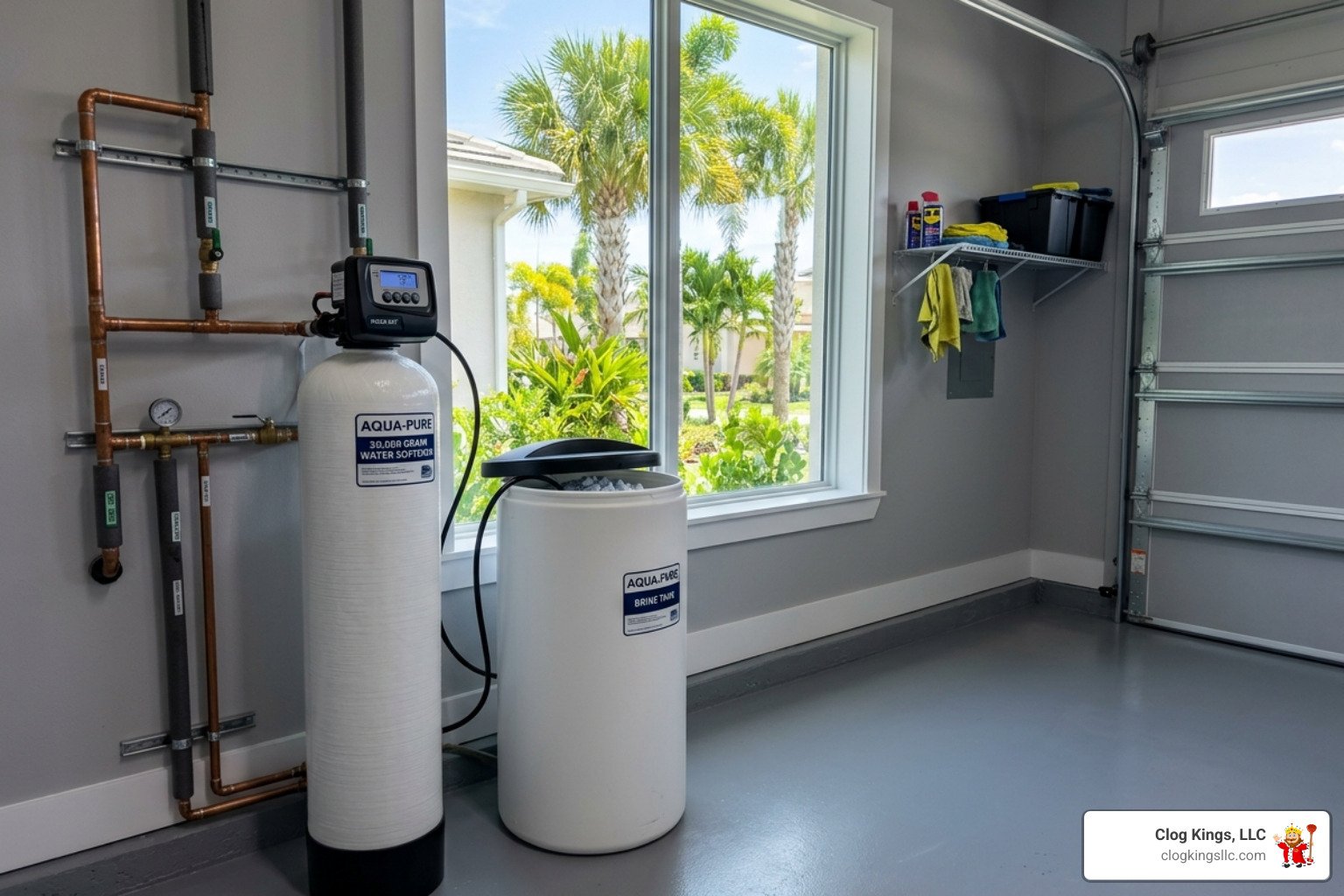

Is a 30,000 Grain Water Softener Right for Your Home?
A 30000 grain water softener is one of the most popular sizes for American households — and for good reason. Here’s a quick breakdown of what you need to know:
- What it does: Removes hardness minerals (calcium and magnesium) from your water using an ion exchange process
- Best for: Households of 1-4 people with moderate to hard water
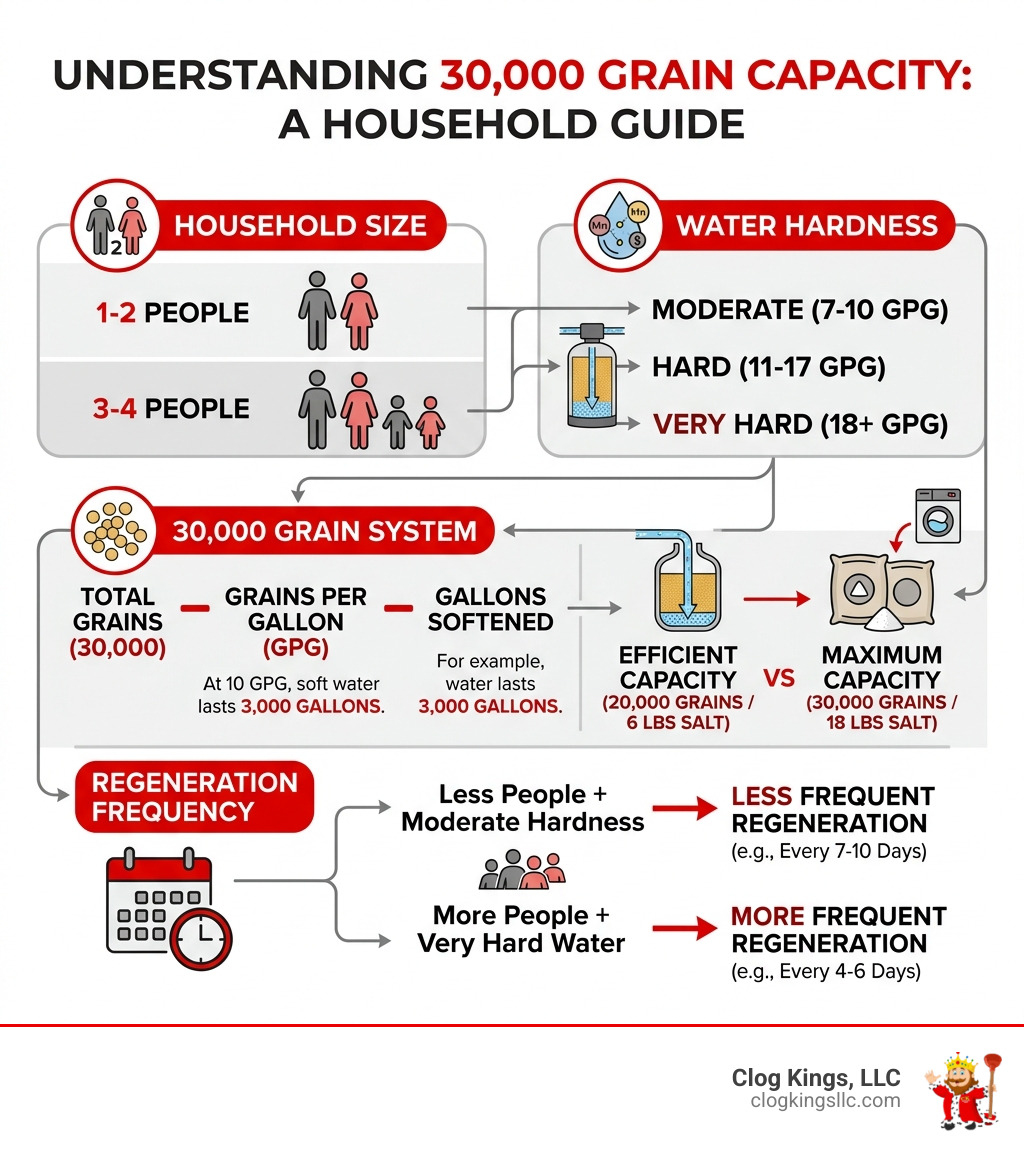
- Grain capacity explained: At 10 grains per gallon (GPG) of hardness, a 30,000 grain system softens about 3,000 gallons before it needs to recharge
- Iron removal: Most models handle up to 7-10 ppm of clear water iron
- Salt use: Ranges from as little as 6 lbs (efficient mode) to 18 lbs (maximum capacity) per regeneration cycle
- Real-world capacity: Advertised at 30,000 grains, but efficient operation typically delivers around 20,000 grains using just 6 lbs of salt
If you have hard water in Florida — and most homeowners in Pasco, Manatee, Pinellas, and Hillsborough counties do — the right water softener can protect your plumbing, extend appliance life, and save money on soap and energy bills. But choosing the wrong size or programming it incorrectly can lead to wasted salt, hard water breakthrough, or frequent valve wear.
This guide walks you through everything: how grain capacity actually works, which household size it fits, top models compared side by side, and how to install and maintain your system for the long haul.
I’m Joey Denick, and with over 20 years of hands-on plumbing experience, I’ve helped hundreds of Florida homeowners select and install the right 30000 grain water softener for their specific water conditions. Let’s make sure you get the right fit the first time.
Understanding the 30000 Grain Water Softener
When we talk about a 30000 grain water softener, we are referring to its “capacity.” But what is a grain, anyway? In the water treatment world, a “grain” is a unit of weight. Specifically, one grain of hardness is equal to 1/7,000th of a pound of dissolved calcium and magnesium.
The heart of the system is the resin tank, which contains specially formulated resin beads. A standard 30000 grain water softener typically contains about 0.8 to 1.0 cubic foot of resin. These beads act like a magnet for hardness minerals. As hard water flows through the tank, the calcium and magnesium ions stick to the resin, while “soft” sodium ions are released into your water. This is the ion exchange process.

It is important to understand that “30,000 grains” is often a laboratory maximum. To hit that number in the real world, you would have to use a massive amount of salt—about 18 pounds per cycle. Most modern systems are designed to be more efficient, often operating at around 20,000 to 24,000 grains of actual capacity to save you money on salt. If you want to dive deeper into the technical specs of these units, you can learn more about 30,000-grain system specifications.
Sizing and Calculation: Is it Right for Your Household?
Choosing the right size isn’t just about how many bathrooms you have; it’s a math problem involving your water hardness and your daily usage. Generally, a 30000 grain water softener is the “Goldilocks” size for families of 1 to 4 people. It’s large enough to handle typical Florida water but compact enough to fit in a garage or utility closet.
To know if it fits your home, you first need a hardness test. Water hardness is measured in Grains Per Gallon (GPG). In our service areas like Tampa and St. Petersburg, water can range from moderately hard to “rock hard.”
Here is the basic formula we use at Clog Kings:
- People in home x 75 gallons (avg. daily use) = Total daily water use.
- Daily water use x GPG of hardness = Daily grains to be removed.
- Softener capacity (e.g., 30,000) / Daily grains = Days between regenerations.
We generally recommend that a system regenerates every 6 to 10 days. If it regenerates every day, the system is too small. If it goes three weeks without regenerating, the resin bed can become packed with sediment or grow bacteria. For more context, check out the ultimate guide to water softener benefits.
[TABLE] Comparing Household Size and Hardness
| Household Size | Water Hardness (GPG) | Daily Grains Needed | Days Between Recharges |
|---|---|---|---|
| 1-2 People | 10 GPG | 1,500 | ~20 Days (Over-sized) |
| 2-3 People | 15 GPG | 3,375 | ~9 Days (Ideal) |
| 4 People | 20 GPG | 6,000 | ~5 Days (Working Hard) |
| 5+ People | 25+ GPG | 9,375+ | ~3 Days (Under-sized) |
Calculating Capacity for a 30,000 Grain Water Softener
When a manufacturer says “30,000 grains,” they are using “lab conditions.” In your home, we have to account for “reserve capacity.” Most smart valves monitor your usage and leave a little bit of softening power in the tank (usually about one day’s worth) so you don’t experience “hard water breakthrough” in the middle of a shower.
If your water has 10 GPG of hardness, a 30000 grain water softener theoretically provides a 3,000-gallon threshold (30,000 / 10 = 3,000). However, if you set the system for maximum salt efficiency, that threshold drops to about 2,000 gallons. This ensures you aren’t dumping unnecessary salt down the drain while still keeping your water silky smooth.
Efficiency Matters: Salt Usage and Regeneration Settings
Efficiency is where most homeowners get confused. There is a massive difference between “Capacity” and “Efficiency.”
- Maximum Capacity: Uses ~18 lbs of salt to get 30,000 grains.
- High Efficiency: Uses ~6 lbs of salt to get 20,000 grains.
Notice the math? By using only one-third of the salt, you still get two-thirds of the capacity. This is why we almost always recommend the 6-lb setting. It results in a Salt Efficiency Rating (SER) of about 3,333 to 4,800 grains per pound of salt. Over a year, this can save you hundreds of pounds of salt and significantly reduce the environmental impact on our Florida groundwater.
Using high-quality salt also helps. For peak performance, we suggest evaporated salt pellets or solar salt crystals with less than 1% impurities. Avoid block salt, as it can lead to “bridging” (a hard crust in the salt tank) and mechanical failures. You can find more recommended salt types for peak performance from industry experts. Proper settings don’t just save salt; they provide more info about water softener protection for plumbing by preventing scale buildup in your pipes.
Top Features and Iron Removal Capabilities
Modern 30000 grain water softener models are much smarter than the old “timer-based” units. Look for these “must-have” features:
- Demand-Initiated Regeneration: The system uses a water meter to track exactly how much water you use. It only recharges when the resin is actually exhausted, saving up to 60% in salt compared to older models.
- Autosense/Predictive Technology: Some units, like those from GE or Whirlpool, “learn” your habits. If you always do laundry on Saturdays, the system will predict that usage and regenerate on Friday night.
- NSF Certification: Always look for NSF/ANSI 44 certification. This means the system has been independently tested to prove it actually removes the hardness it claims to.
- Iron Removal: If you are on a well in Pasco or Hillsborough County, you likely have “clear water iron” (ferrous iron). Many 30,000 grain units can remove between 7 and 10 ppm of iron. However, if your iron levels are higher, you may need a specialized iron filter or fine-mesh resin.
For a deep dive into how these electronics work, you can check the GE GXSF30V technical specifications.
Comparing Popular 30,000 Grain Water Softener Models
Most 30,000 grain units come in a “cabinet” or “all-in-one” design, where the resin tank sits inside the salt tank to save space.
- Whirlpool WHES30: Features “6th Sense” technology and is very user-friendly. You can view Whirlpool WHES30 manual and features to see if its space-saving design fits your home.
- EcoPure EP7130: Known for its “Autosense” technology and easy DIY setup.
- GE GXSF30V: A reliable workhorse that uses up to 20% less water than older GE models.
- Morton M30: Features “Look-Ahead” technology and is designed for easy installation with a compact footprint.
Installation and Maintenance Guide
While many of these units are marketed as “DIY friendly,” professional installation is often the safer bet in Florida. Our local plumbing codes are specific, and ensuring the drain line and overflow are handled correctly prevents basement or garage flooding.
Maintenance Checklist:
- Check Salt Monthly: Keep the salt level at least 1/3 full.
- Clean the Brine Tank: Once a year, let the salt run low and clean out any “sludge” at the bottom.
- Use Resin Cleanser: Every 4 months, add a bottle of resin bed cleanser to strip away iron and sediment that salt can’t remove. This can actually extend your manufacturer’s warranty from 1 year to 5 years on many models.
- Watch the “Low Salt” Light: Most modern units have an alarm to remind you when it’s time to refill.
If you’re in Pinellas Park or Clearwater, we offer professional water softener installation services to ensure your system is calibrated for our specific water conditions. There are many benefits of installation in Pinellas County, including stopping the “white crust” from ruining your expensive faucets.
Frequently Asked Questions
How long does a 30,000 grain water softener last?
A high-quality 30000 grain water softener typically lasts between 10 and 15 years. The lifespan depends heavily on your water quality (chlorine eats resin beads!) and how well you maintain it. Using a pre-filter to catch sediment and keeping the salt tank clean are the best ways to hit that 15-year mark.
How much salt does a 30,000 grain softener use?
On average, a family of four with moderately hard water will use about 16 bags (40 lbs each) of salt per year. If you set your system to high-efficiency mode (6 lbs per recharge), you can significantly reduce this number.
Can a 30,000 grain softener handle well water with high iron?
Yes, but with limits. Most are rated for 7 ppm of clear water iron. If your water comes out of the tap looking orange or rusty, that is “ferric iron,” and a standard softener won’t catch it—you’ll need a dedicated iron filter. For “clear water iron,” ensure you use a salt with an iron-out additive or a regular resin cleanser.
Conclusion
Choosing a 30000 grain water softener is a smart move for most small-to-medium households in Florida. It strikes the perfect balance between salt efficiency, space-saving design, and effective mineral removal. Whether you are dealing with the hard city water of Tampa or the iron-heavy well water in rural Pasco County, these systems provide the protection your home deserves.
At Clog Kings LLC, we pride ourselves on being the local experts for our neighbors in Pasco, Manatee, Pinellas, and Hillsborough Counties. We don’t just “drop a box” in your garage; we test your water, calculate your usage, and program your system for maximum efficiency.
Don’t let hard water continue to wear down your pipes and dry out your skin. We offer 24/7 plumbing support and expert advice on all things water treatment. Schedule your water softener consultation today and experience the Clog Kings difference!
