

The Luxury of Clean Water: Why Whole-House Filtration Is No Longer Optional in Pinellas County
For coastal homeowners in St. Petersburg, Clearwater, and Largo, pristine water used to be considered a resort-level luxury. Today, it’s a necessary defense mechanism for your home’s plumbing, your appliances, and your family’s daily health.
While Pinellas County Utilities works diligently to meet minimum federal standards, municipal water traveling through miles of aging underground mainlines picks up heavy mineral loads, disinfectant chemicals, and micro-particulates before reaching your kitchen tap or showerhead.
When you step into a luxury resort shower or pour a crystal-clear glass of tap water in a five-star hotel, the experience feels noticeably different. The water feels soft against your skin, lacks any chemical or pool-like odor, leaves no spotty white film on glass surfaces, and tastes completely refreshing.
For decades, coastal property owners across Pinellas, Pasco, Hillsborough, and Manatee Counties viewed this level of water purity as an exclusive resort luxury—an expensive indulgence reserved for boutique hotels or high-end spa retreats.
In 2026, that perspective has fundamentally shifted. Embracing the luxury of clean water is no longer a matter of aesthetic preference or lifestyle status; it has become an indispensable, proactive defense strategy for residential property owners throughout St. Petersburg, Clearwater, Largo, Dunedin, and Tarpon Springs.
While municipal utility providers in Pinellas County work continuously to treat public reservoirs and satisfy minimum federal standards managed by the Environmental Protection Agency, the journey that water takes from central treatment plants to your kitchen sink introduces significant hidden hazards.
Traversing dozens of miles of subterranean municipal mains, water absorbs mineral scaling, environmental particulates, and heavy chemical disinfectant loads. By the time it arrives at your property’s primary water meter, untreated tap water carries a cocktail of dissolved calcium, magnesium, chloramines, volatile organic compounds (VOCs), and residual heavy metals.
Left unchecked, these elements silently attack your household plumbing infrastructure, destroy high-efficiency appliances, cause recurring plumbing leaks, and compromise your family’s daily comfort.
Why the Problem Is Worse Than It Looks
To most homeowners in Pinellas County, water appears completely clear as it pours from the tap. If it doesn’t look muddy or taste noticeably foul, the assumption is that it poses no threat to your home.
However, the primary water quality issues destroying residential plumbing networks operate entirely at a microscopic chemical level.
The Hidden Drivers of Water Quality Degradation in Pinellas County
Residential properties across Pinellas County face a unique combination of coastal geological factors and aggressive municipal treatment protocols that compound internal plumbing stress:
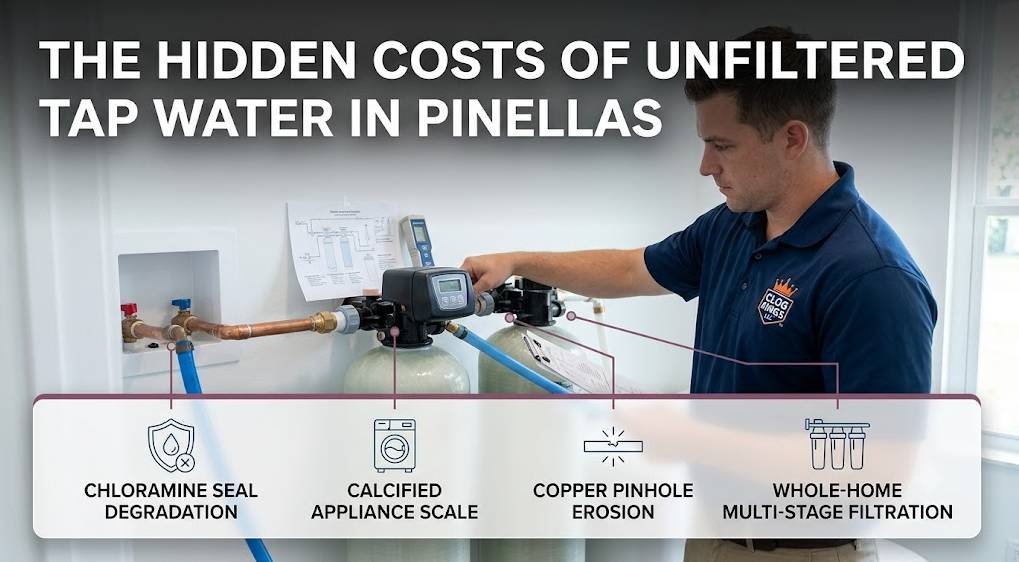
Chloramine Burnouts & Chemical Oxidation: Pinellas County Utilities frequently performs system-wide “chlorine burnouts” or uses persistent chloramines (a combination of chlorine and ammonia) to kill bacteria across hundreds of miles of flat, coastal supply lines. While effective for public sanitation, chloramines are highly aggressive oxidizers. They degrade internal rubber washing machine hoses, corrode toilet fill valve seals, off-gas inside warm, enclosed shower stalls, and strip natural oils from hair and skin.
Hard Water Mineral Precipitation: Florida’s drinking water is drawn heavily from underground limestone aquifers. As a result, tap water carries heavy concentrations of dissolved calcium carbonate and magnesium. When this hard water is heated inside tankless units or traditional water heaters, the minerals instantly precipitate out of solution, forming a rock-hard calcified crust on heating elements, shower doors, and internal pipe bends.
Pinhole Copper Erosion & Slab Leaks: The combination of elevated total dissolved solids (TDS), fluctuating municipal pH levels, and continuous chemical velocity scours the interior of residential copper pipes. Over years of service, this continuous friction thins internal pipe walls, eventually creating pinhole leaks hidden beneath concrete foundation slabs and inside finished drywall.
⚠️ HOMEOWNER WARNING: The Pitcher Filter Delusion
Many homeowners attempt to solve water quality concerns by placing countertop pitcher filters or refrigerator door pods in their kitchens. This provides a false sense of security. Pitcher filters rely on tiny activated carbon cartridges that remove only basic chlorine taste from a single gallon of drinking water at a time. They leave 99% of your home’s water completely untreated. Your shower heads, washing machines, dishwashers, hot water tanks, and underlying pipe networks remain entirely exposed to aggressive chloramines and calcifying minerals.
The Professional Approach vs. DIY
Attempting to resolve complex coastal water chemistry issues with off-the-shelf point-of-use attachments or uncertified hardware store softeners usually leads to disappointing water quality, restricted flow rates, and unexpected plumbing leaks.
Installing an undersized water treatment system without analyzing your incoming flow velocity and line pressure can choke your home’s water volume, making it impossible to run a shower and a washing machine simultaneously.
[Countertop Pitcher / DIY Attachment] ──> Treated Drinking Water Only ──> Unprotected Plumbing & Appliances ──> Accelerated Scale & Leak Risk
[Master Point-of-Entry Filtration] ──> Total Line Treatment ──> Pristine Water at Every Tap ──> Complete Infrastructure Protection
A master technician treats water purification as a precise engineering discipline. Before recommending any hardware, our team conducts a comprehensive water quality and pressure audit at your property’s main line cleanout and primary entry point.
If hard mineral scale or chemical degradation has already caused sluggish drainage or fixture backing up inside your home, our team deploys an advanced fiber-optic video plumbing inspection through cleanouts. This camera pass allows us to assess internal pipe health, inspect joint integrity, and identify scale buildup without cutting open your walls.
When mineral scaling or heavy organic debris is found choking downstream drainage lines, we execute targeted drain cleaning passes using high-pressure hydro-jetting to scour pipe interiors clean and restore optimal hydraulic capacity.
“True clean water is not just about drinking taste—it is about total environmental control over your home’s liquid circulatory system. Filtering water at the point of entry neutralizes chemical oxidizers and hard minerals before they can touch a single pipe, valve, or appliance.”
All of our commercial and residential water treatment installations conform strictly to rigorous standards set by the International Association of Plumbing and Mechanical Officials and meet all state and local Florida plumbing codes.
Technical Comparison: Water Treatment Technologies
Understanding the difference between available water treatment systems allows property owners to select the exact level of protection required for their specific municipal supply:
| Filtration Technology | Contaminant Target Profile | Scale & Mineral Protection Level | Scope of Property Coverage | Typical Maintenance Interval |
| Point-of-Use Pitcher Filters | Basic Chlorine Taste & Odor | Zero Protection: Scale continues building on all fixtures. | Single Pitcher / One Tap | 30 to 60 Days (High Cartridge Cost) |
| Under-Sink Reverse Osmosis | Heavy Metals, Fluoride, Microplastics, TDS | Localized: Protects ice maker and dedicated drinking faucet only. | Kitchen Sink Only | 6 to 12 Months (Filter Media Swaps) |
| Salt-Based Water Softener | Dissolved Calcium & Magnesium | High: Converts hard minerals via ion exchange process. | Whole Home (Requires Drain Loop) | Monthly (Heavy Salt Bag Loading) |
| Salt-Free Water Conditioner | Hard Scale Crystallization | High: Alters mineral structure to prevent scale adhesion without salt. | Whole Home | 12 to 24 Months |
| Multi-Stage Whole-House System | Chloramines, VOCs, Heavy Metals, Sediments, Micro-Particulates | Maximum (When Paired with Conditioner): Total chemical & mineral defense. | Every Tap, Shower, Hose Bib & Appliance | 1 to 3 Years (Depending on Media Size) |
Step-by-Step: The Whole-House Installation Process
Executing a seamless whole-house filtration and conditioning installation requires precise hydraulic planning to ensure zero loss in household water pressure.
Technicians measure incoming static line pressure, gallon-per-minute (GPM) flow capacity, total dissolved solids (TDS), chlorine/chloramine concentrations, and mineral hardness grains at your primary supply line.
We cut into your home’s primary incoming cold water main before it branches off to water heaters or interior taps, constructing a heavy-duty bypass manifold using high-grade copper or PEX fittings with dual isolation shut-off valves.
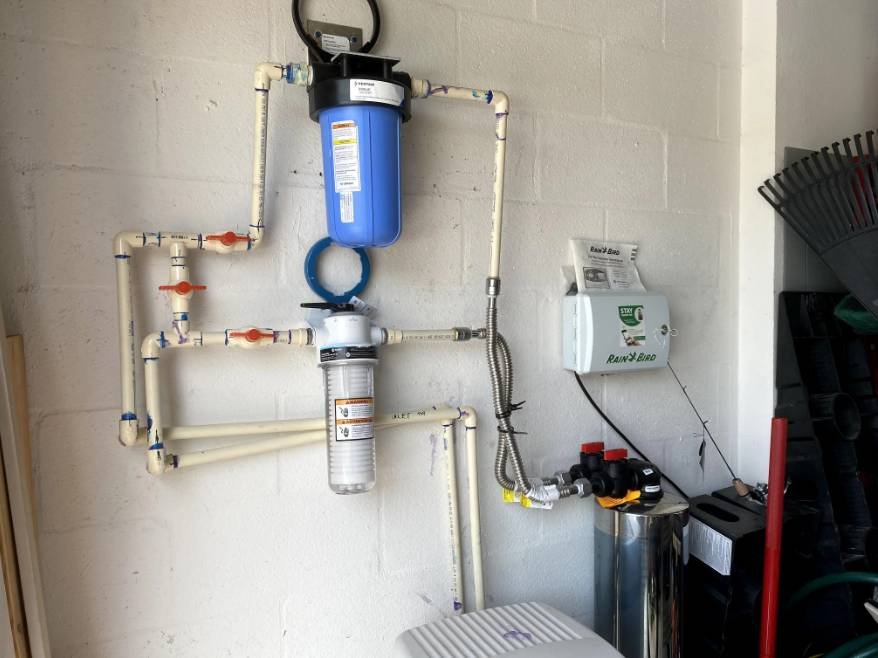
A high-capacity sediment pre-filter is mounted to trap sand, rust flakes, and pipe scale from the street, followed by the primary activated catalytic carbon and conditioning media tanks securely anchored to the slab.
The new filtration tanks undergo a controlled, high-velocity backward flush to clear fine carbon particles and sanitize media beds prior to sending water through your interior plumbing lines.
The entire system is pressurized, thoroughly leak-checked under high hydraulic load, and verified across all showers and faucets to ensure consistent, high-volume water flow throughout the property.
The Real Cost of Waiting
Let’s talk about what ignoring this problem actually costs you.
Allowing harsh chloramines, heavy mineral scale, and corrosive particulates to circulate freely through your home is an expensive financial gamble. The incremental damage inflicted on your water heater, appliances, and pipe walls creates a steady stream of unbudgeted repair bills that far exceed the investment of a whole-home filtration system.
The table below breaks down the long-term financial and infrastructure consequences of untreated municipal water versus proactive point-of-entry filtration:
| Infrastructure Impact Phase | Untreated Water Financial Consequence | Property Infrastructure Risk Profile | Lifespan Expectancy Impact |
Water Heater Performance Tankless or traditional tank heating elements accumulation of calcified scale. | $800 – $2,200 (Premature failure & high electric/gas utility bills) | High Risk: Tank sediment buildup causes thermal stress, leading to tank bottom rupture or element burnouts. | Reduced by 30% to 50% |
Kitchen & Laundry Appliances Dishwasher pumps, washing machine valves, and ice maker solenoids clogged by scale. | $1,200 – $4,500 (Frequent appliance replacement & repair calls) | Moderate to High Risk: Hard scale destroys internal rubber seals and glass door clarity, causing leaks. | Reduced by 40% |
Piping & Fixture Infrastructure Copper pinhole leaks, corroded shower valves, and stained granite/glass surfaces. | $3,500 – $15,000+ (Sub-slab leak repairs, wall restoration, valve replacements) | Critical Risk: Continuous chemical oxidation thins copper walls, triggering subterranean slab leaks. | Reduced by 50% |
Proactive Whole-House System Multi-stage catalytic carbon filtration & salt-free scale conditioning installed. | $1,800 – $4,500 (Single capital investment with minimal yearly service) | Zero Risk: Total defense against chloramines, scale, and pinhole corrosion across all household fixtures. | Extended to Maximum Design Life |
If unaddressed water hardness and corrosion have already caused structural pipe leaks or foundation damage underneath your home, our certified technicians perform precision sewer repair to restore subterranean piping before foundation erosion occurs.
If your home’s older plumbing network shows signs of widespread joint degradation from years of exposure to harsh chemicals, arranging a targeted general plumbing repair ensures your entire system operates safely under standard municipal pressure.
“Investing in whole-house water filtration is like putting an invisible shield around your home’s entire plumbing network. It turns every faucet into a pure spring while protecting your water heater, appliances, and subfloors from costly chemical and mineral destruction.”
Why Clog Kings
Clog Kings LLC is committed to providing master-level water treatment, plumbing restoration, and diagnostic services across Pinellas, Pasco, Hillsborough, and Manatee Counties. We are fully licensed, bonded, and insured, holding active state corporate licensing with the Florida Department of Business and Professional Regulation.
Our master plumbing team possesses deep, localized expertise in Central Florida coastal water conditions. We understand the specific municipal treatment schedules, seasonal water shifts, and piping challenges unique to neighborhoods throughout St. Petersburg, Clearwater, Largo, Seminol, and Tarpon Springs.
We operate with absolute financial integrity, providing transparent, flat-rate pricing up front so you never encounter hidden fees or unexpected add-ons. To support those who have built and served our local communities, we offer dedicated senior and military veteran discounts across all our plumbing and filtration services.
Whether you need a quick toilet repair to replace seals damaged by aggressive chloramines or a custom multi-stage whole-house water purification array, Clog Kings delivers uncompromising quality.
Recently, a family living in Historic Kenwood, St. Petersburg, experienced repeating water heater element failures, dry skin, and severe white scale buildup on their custom tile showers. They were replacing appliances every three years. Our team completed a comprehensive water quality audit, installed a high-flow catalytic carbon filtration array paired with a salt-free conditioner, and completely eliminated the chloramine odor and hard scale. One year later, their water heating efficiency is up, their shower glass remains spotless, and their household water feels like a luxury resort.
What to Expect When You Call Us
We take all the guesswork out of upgrading your home’s water quality through a transparent, 4-phase client experience:
Phase 1: Rapid Local Dispatch: Our team logs your inquiry, reviews your current water quality symptoms, and dispatches a fully equipped water treatment specialist directly to your home.
Phase 2: Master Water & Diagnostic Audit: We test your water’s TDS, hardness grains, chlorine/chloramine levels, and static line pressure at the main meter, mapping out your ideal system placement.
Phase 3: Clear Digital Briefing & System Design: We present a transparent digital report outlining exact water test results, explaining system sizing options, and providing straightforward flat-rate pricing. If your current hot water unit is calcified beyond recovery, we can include a seamless water heater replacement plan to restore your hot water capacity.
Phase 4: Precision Installation & Verification: Our master plumbers complete the point-of-entry installation, flush the system media, perform rigorous pressure and leak checks, verify flow rates across all fixtures, and clean up the work area completely.
Quick Answers: Frequently Asked Questions
How long does drain cleaning take?
A standard professional drain cleaning service typically takes 1 to 2 hours to complete. If the line contains severe calcified grease, dense tree root intrusion, or requires an extensive high-definition video camera inspection, the process can take between 2 and 4 hours.
What is the difference between a water filter and a water softener?
A water filter removes chemical contaminants, chloramines, VOCs, heavy metals, sediment, and unpleasant odors from your water supply. A water softener or conditioner specifically targets dissolved hardness minerals like calcium and magnesium, preventing them from forming hard scale on pipe walls, fixtures, and heating elements. Combining both technologies gives your home total water purity and scale protection.
Will a whole-house water filtration system reduce my shower water pressure?
No—provided the system is properly sized by a professional plumber. By analyzing your home’s peak gallon-per-minute (GPM) demand and main water line diameter, we install custom high-flow filter tanks and bypass manifolds that maintain full water pressure across all showers, faucets, and outdoor spigots simultaneously.
How does hard water impact household water heating equipment?
When hard water is heated inside a tank or tankless unit, calcium and magnesium minerals solidify and drop to the bottom of the tank or coat the heat exchanger bundle. This mineral layer acts as a thermal insulator, forcing the unit to run longer and burn more electricity or gas to heat water. Over time, this causes thermal stress, noisy tank rumbling, element burnouts, and premature tank failure. Installing a dedicated water softener installation or salt-free conditioner eliminates mineral bonding and protects your heating investment.
For total whole-home defense, pairing hard water conditioning with advanced whole-house water filtration guarantees that every drop of water used for cooking, bathing, washing, and drinking is pure, soft, and safe.
The Fix Starts with a Call
Your plumbing system is the most overlooked infrastructure in your home. Until it fails.
Don’t let aggressive chloramines, heavy calcium scale, and abrasive micro-particulates ruin your appliances, corrode your piping, or compromise your family’s daily comfort. Embracing the luxury of clean water gives you total peace of mind, pristine water from every tap, and ironclad protection for your property value.
While upgrading your home’s water quality, consider pairing your filtration system with a high-efficiency tankless water heater installation. Compact tankless units supply continuous, endless hot water on demand while meeting rigid energy efficiency guidelines managed by EPA WaterSense.
Take proactive control of your home’s water quality today:
Request Your Evaluation: Get Your Free Estimate from Clog Kings by connecting with our online portal to book your home water quality audit.
24/7 Emergency Dispatch: If your water system is experiencing active line leaks, severe pressure loss, or pipe failures, call us immediately at 727-479-4028 for priority technician routing.
Explore Full-Home Options: Speak with our specialists about custom whole-house filtration, salt-free water conditioners, and high-efficiency water heating upgrades tailored to your home’s unique footprint.
We serve homeowners across St. Petersburg, Clearwater, and the greater Tampa Bay area with 24/7 emergency dispatch, transparent pricing, and master-level diagnostic integrity. Contact our team today!
