

Your Cast Iron Pipes Are Aging — Here’s What You Can Do About It
Cast iron pipe relining is a trenchless repair method that restores damaged or corroded sewer pipes from the inside — no digging up your floors, yard, or driveway required.
Here’s a quick summary of what you need to know:
| Question | Quick Answer |
|---|---|
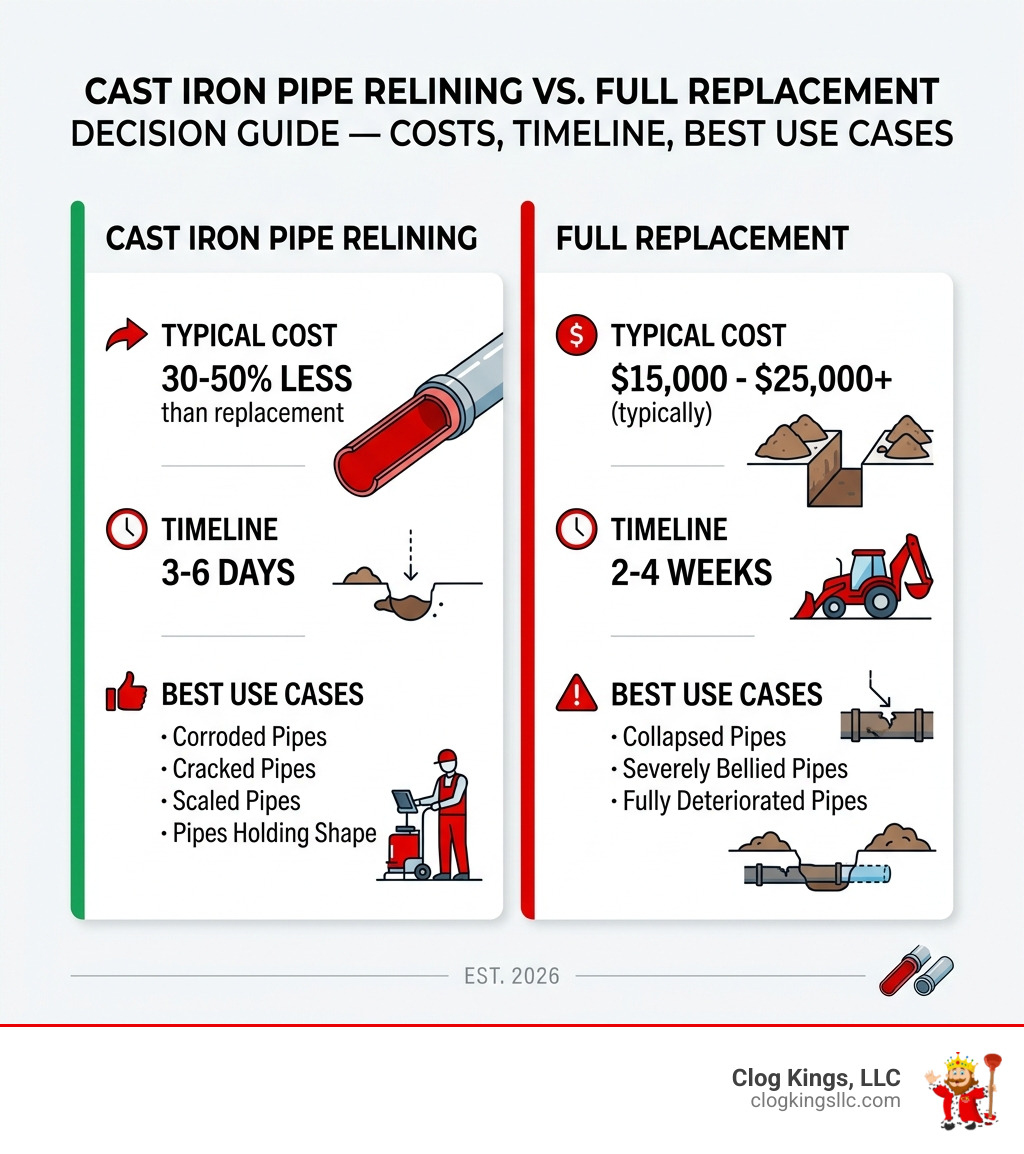
| What is it? | A liner coated in epoxy resin is inserted into your old pipe and cured into a hard, new “pipe within a pipe” |
| How long does it last? | 50+ years with a transferable warranty |
| How much does it cost? | Typically 30–50% less than full excavation and replacement |
| How long does it take? | Usually 3–6 days, vs. 2–4 weeks for traditional replacement |
| Who is it best for? | Homeowners with corroded, cracked, or scaled pipes that still hold their shape |
| When does it not work? | Collapsed, severely bellied, or fully deteriorated pipes may need full replacement |
If you own an older home in Florida — especially one built before the 1970s — there’s a good chance your sewer drains are cast iron. And cast iron, as durable as it once was, corrodes from the inside out. Over time, rust, scale, and cracks build up until you start seeing slow drains, sewage odors, or full-on backups.
The traditional fix? Jackhammers, trenches, torn-up landscaping, and bills that can run anywhere from $15,000 to $25,000 or more. But there’s a smarter option most homeowners don’t know about until they’re already in crisis mode.
That’s exactly what this guide covers.
I’m Joey Denick, and with over 20 years of hands-on experience in cast iron pipe relining and trenchless sewer repair, I’ve helped hundreds of Florida homeowners avoid costly excavations and restore their pipes to like-new condition. In the sections below, I’ll walk you through everything — from how the relining process works to when it’s the right call and when it isn’t.
What is Cast Iron Pipe Relining and How Does It Work?
At its core, cast iron pipe relining is about rehabilitation rather than demolition. Instead of pulling the old pipe out of the ground, we use the existing “host” pipe as a mold to create a brand-new, structurally sound pipe inside of it.
The industry term for this is Cured-in-Place Pipe (CIPP). We take a flexible felt or polyester liner, saturate it with a high-strength epoxy resin, and pull or blow it into the damaged cast iron line. Once it’s in position, we inflate an internal bladder (like a long, skinny balloon) that presses the resin-soaked liner against the inner walls of the old pipe.
As the resin cures—a process that involves a cool chemical reaction that generates heat—it hardens into a rock-solid, seamless sleeve. This “pipe within a pipe” is smooth, jointless, and incredibly strong. It’s not just a coating; it’s a structural repair that can stand on its own even if the original cast iron eventually flakes away entirely. You can learn more info about pipe lining solutions to see how this modern tech is changing the plumbing game.
For those who love the technical details, there is extensive scientific research on cleaning and relining pipes that proves this method is a sustainable way to manage aging infrastructure without the massive carbon footprint of heavy excavation.
The Step-by-Step Process of Cast Iron Pipe Relining
We don’t just “slap a sticker” on the inside of your pipes. The process is surgical and precise.
- Initial Video Inspection: We start by sending a high-resolution camera down the line. We need to see exactly where the cracks are, how much scale has built up, and if there are any “bellies” (low spots) in the line. Video plumbing inspections are the most important part of the job because they tell us if your pipe is a good candidate for lining.
- Mechanical Descaling: Old cast iron gets “tuberculation”—basically rock-hard rust boils that shrink a 4-inch pipe down to 2 inches. We use specialized tools, like carbide chains rotating at high speeds (often 600 RPM), to scrape that rust away and return the pipe to its original diameter.
- Hydro-jetting: Once the rust is scraped loose, we use high-pressure water (hydro-jetting) to flush all the debris, grease, and roots out of the line. The pipe must be “white-metal clean” for the epoxy to bond properly.
- Resin Saturation and Insertion: We measure the pipe exactly, cut the liner, and soak it in the two-part epoxy resin. This is then inserted into the pipe through an existing cleanout or a small access point.
- Curing: The bladder is inflated, and we wait. Depending on the resin used, curing can take anywhere from 1 to 4 hours.
- Final Verification: We remove the bladder and run the camera through one last time. We want to show you a smooth, shiny, “new” pipe interior that is ready for another 50 years of service.
Comparing CIPP, Epoxy Coating, and Pipe Bursting
Not all trenchless methods are created equal. Depending on the damage, we might use different “flavors” of technology:
- CIPP (Cured-in-Place Pipe): The gold standard for residential sewer lines. It provides a full structural “sleeve” that handles the load of the soil and traffic above.
- Epoxy Coating (Brush/Spray-in): This is often used for smaller vertical stacks or pipes with many bends. It’s a thinner layer of epoxy applied by a spinning brush or spray nozzle. It’s great for sealing pinhole leaks but provides less structural “beef” than a CIPP liner.
- Pipe Bursting: This is a more aggressive trenchless method. We pull a heavy “bursting head” through the old pipe, which literally breaks the cast iron apart and pushes it into the surrounding soil while simultaneously pulling a new HDPE (High-Density Polyethylene) pipe behind it. This is best if you need to “upsize” your pipe to a larger diameter.
- Slip Lining: An older method where a smaller pipe is simply slid inside the big one. The downside? It significantly reduces your flow capacity because of the smaller diameter and the gap (annular space) left between the two pipes.
| Feature | CIPP Relining | Pipe Bursting | Traditional Excavation |
|---|---|---|---|
| Disruption | Minimal (1 small hole) | Moderate (2 holes) | High (Full trench) |
| Time | 3–6 Days | 3–5 Days | 2–4 Weeks |
| Property Damage | None to low | Low | High |
| Lifespan | 50+ Years | 100 Years | 100 Years |
| Cost | $$ | $$$ | $$$$ |
Relining vs. Traditional Replacement: Which Is Right for You?
The “dig and replace” method is exactly what it sounds like. If your sewer line runs under your living room, we’d have to jackhammer your tile or hardwood, dig a 4-foot deep trench through your house, replace the pipe, and then try to find matching flooring (which is usually impossible).
This is why cast iron pipe relining is so popular in places like St. Petersburg and Tampa. Many of our homes are built on concrete slabs. A “slab leak” or a sewer failure under the foundation is a nightmare with traditional tools. If you’re seeing signs you should replace your plumbing, you have to weigh the cost of the plumbing against the cost of the restoration.
When deciding when to replace vs repair your sewer line, look at the “collateral damage.” If the pipe is under a pristine lawn or a paved driveway, relining saves you the cost of a new landscaper or a paving crew.
Cost Differences and Real-World Savings
Let’s talk numbers. For a typical residential property in Pinellas or Hillsborough County, a full cast iron replacement can easily cost between $15,000 and $25,000. If you have 50 feet of pipe under a landscaped yard, the excavation and restoration alone can eat up $12,000 of that budget.
In contrast, trenchless relining typically costs 30% to 50% less than a full “dig-and-replace” project. Why? Because you aren’t paying for:
- Backhoe rentals.
- Dozens of man-hours for manual digging.
- Dumpster fees for old concrete and dirt.
- New sod, trees, or driveway repairs.
For commercial projects—like a restaurant that can’t afford to close for three weeks—the savings are even higher. We can often finish a commercial lining job in a few days, allowing the business to stay open for 20 hours out of the day.
When Full Replacement is Necessary
We love relining, but it isn’t magic. There are times when we have to tell a homeowner that the “trenchless” dream isn’t possible. Approximately 15% of pipes we inspect are too far gone for CIPP.
You likely need a full replacement if:
- The Pipe has Collapsed: If the “roof” of the pipe has fallen in, we can’t get a liner through it.
- Severe Offsets: If the ground shifted and the pipe joints no longer line up (creating a “step” in the line), the liner will just get stuck or fail.
- Extensive Bellies: If your pipe looks like a roller coaster with deep low spots that hold standing water, a liner won’t fix the slope. You’ll still have clogs because gravity isn’t doing its job.
- Channeling: If the bottom of the cast iron is completely gone (common in Florida), we can sometimes still line it, but if the soil has washed away underneath, there’s no support for the new liner.
Keep an eye out for these red flags of corroded plumbing to catch the problem before the pipe fully collapses.
The Long-Term Benefits and Myths of Trenchless Technology
One of the biggest myths we hear is that relining is a “temporary band-aid.” That couldn’t be further from the truth. Modern CIPP liners are engineered for a 50+ year service life. In fact, some of the earliest relining projects from the late 20th century are still in perfect working order today.
Another myth is that the liner will “clog easier” because it makes the pipe smaller. While the diameter does shrink by a few millimeters, the interior of the epoxy resin is incredibly smooth—much smoother than old, rusty cast iron. This actually improves flow capacity and makes it much harder for waste or “flushable” wipes to snag on the walls.
From an environmental standpoint, relining is a huge win. You aren’t sending old, heavy cast iron to the landfill, and you aren’t disrupting the local ecosystem by churning up yards of soil. There’s a long history of cast iron sustainability, and rehabilitating it with non-toxic resins fits right into that “green” philosophy. All our materials meet strict ASTM standards and federal regulations for safety and durability.
Safety and Insurance Coverage for Cast Iron Pipe Relining
Is it safe? Yes. The resins we use are non-toxic once cured and do not leach chemicals into your groundwater.
What about insurance? This is a big one for Florida homeowners. Many major insurance carriers now recognize and approve trenchless epoxy lining. Because it is a permanent, structural repair that meets building codes, it can actually help maintain or even increase your property value. If you’re dealing with a failure, check your policy—some companies prefer the lower cost of relining over a massive excavation claim. If you’re unsure if your system is failing, look for the signs and symptoms of failing pipes like mysterious wet spots or lush patches of grass in the yard.
Choosing a Reliable Contractor for Your Project
Because this technology is specialized, you shouldn’t hire just any plumber with a truck. You need a specialist.
When you’re looking for a pro in Pasco, Manatee, or Pinellas, ask these questions:
- Do you provide video proof? A reputable contractor will show you the “before” and “after” footage. If they won’t show you the camera screen, walk away.
- Are you licensed and insured for trenchless work? Normal plumbing insurance doesn’t always cover the specific risks of pipe lining.
- What is your cleaning process? If they don’t mention descaling or hydro-jetting, the liner won’t bond, and it will fail within a few years.
- Do you offer a transferable warranty? A 50-year warranty is standard for quality CIPP work.
We take pride in our video plumbing inspections in Hillsborough County, ensuring every homeowner understands the state of their pipes before we ever talk about a contract. There are many reasons to get a video plumbing inspection, even if you aren’t currently having backups—it’s the only way to “see through walls.”
Frequently Asked Questions about Cast Iron Pipe Relining
How long does the relining process take compared to replacement?
For most residential homes, we can have the entire process—inspection, cleaning, and lining—done in 3 to 6 days. A traditional replacement usually takes 2 to 4 weeks once you factor in the digging, the plumbing work, the inspections, and the restoration of your floors and yard.
Will relining restore flow capacity and prevent future backups?
Absolutely. By removing the rust and scale (tuberculation), we restore the pipe to its original size. The new epoxy surface is so slick that it actually improves the speed at which waste moves through your system. Plus, since the liner is seamless, it completely blocks out tree roots—the #1 cause of sewer backups in Florida.
What kind of warranties are typically offered for relined pipes?
At Clog Kings, LLC, we stand behind our work. Most high-quality relining projects come with a 50-year materials and labor warranty. The best part? This warranty is usually transferable, which is a massive selling point if you ever decide to sell your home.
Conclusion
Your home’s sewer system is “out of sight, out of mind”—until it isn’t. If you’re tired of calling a plumber every six months to snake out your old cast iron lines, it’s time to look at a permanent solution.
At Clog Kings, LLC, we specialize in saving Florida homeowners from the stress and mess of traditional excavation. Whether you’re in Pasco, Manatee, Pinellas, or Hillsborough County, our team is available 24/7 to provide expert advice and high-tech solutions. Don’t wait for a total pipe collapse to take action.
Schedule your sewer repair today and let us help you protect your home with the latest in trenchless technology.
