
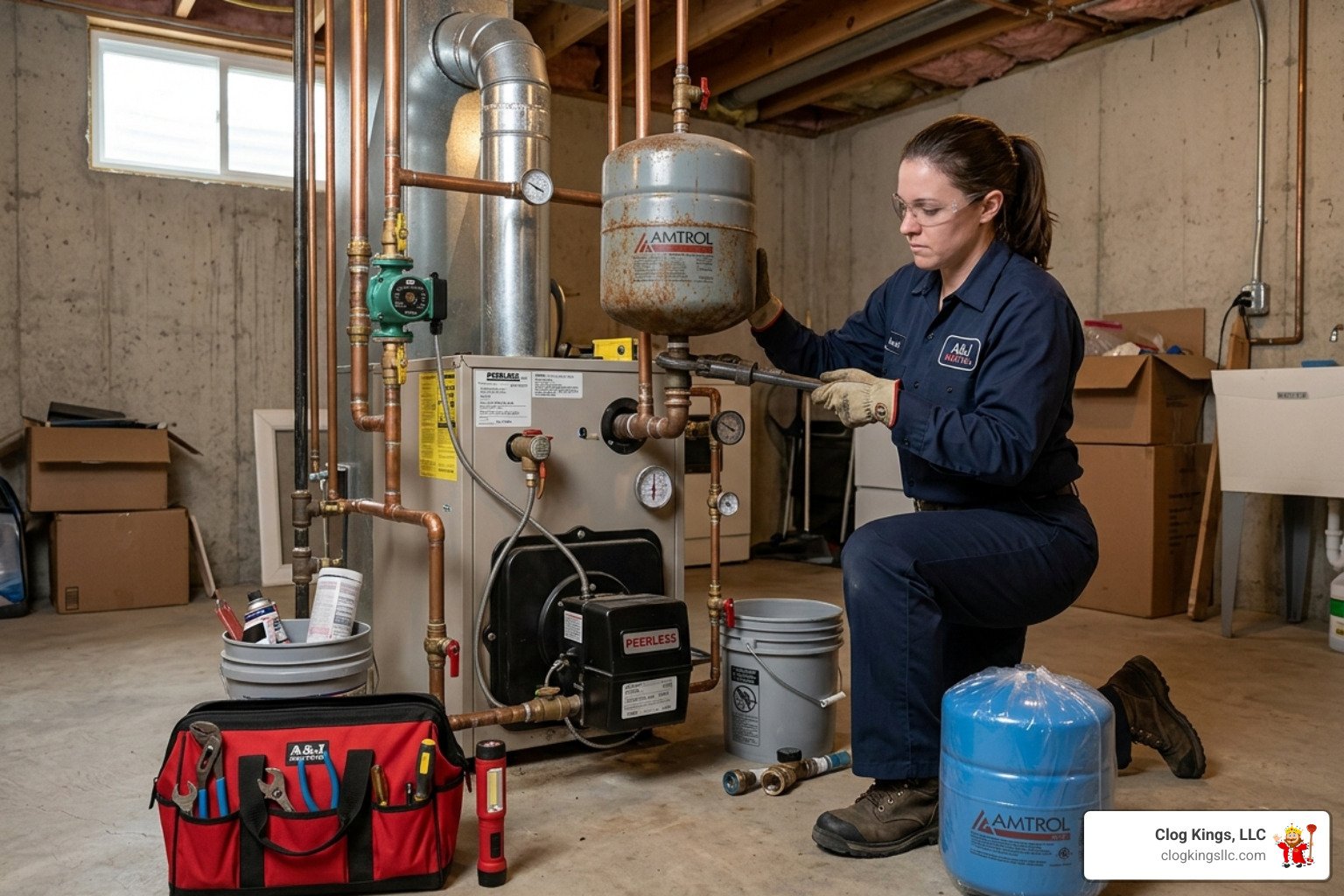

Why Knowing How to Change Expansion Tank on Boiler Systems Can Save You From a Costly Mess
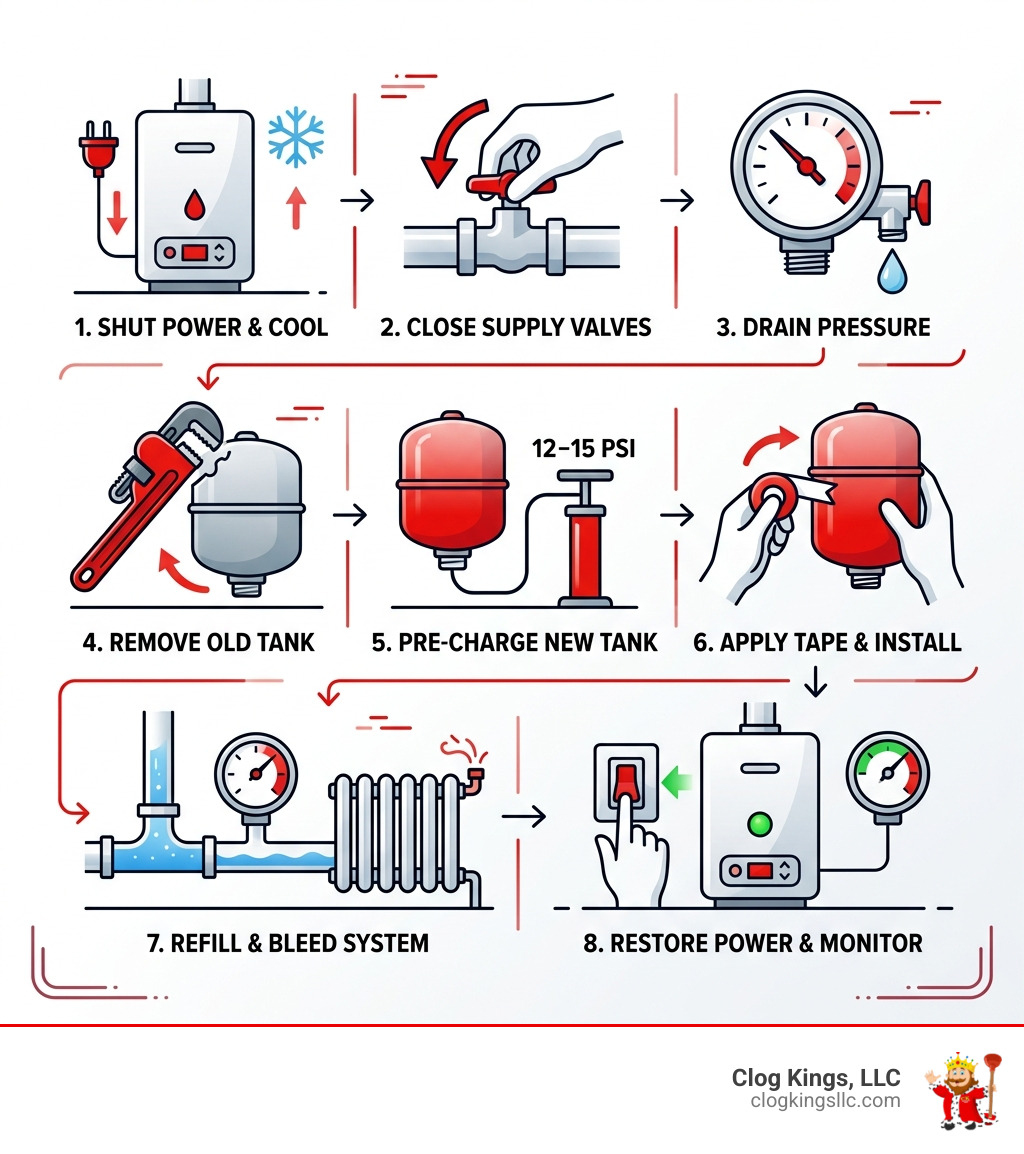
To change expansion tank on boiler systems, here are the core steps:
- Shut off power to the boiler and let it cool completely
- Close the water supply valve and any isolation valves near the tank
- Drain system pressure by opening the relief valve until the gauge reads zero
- Remove the old tank using a pipe wrench
- Pre-charge the new tank to 12-15 PSI before installing
- Apply Teflon tape to the threads and screw in the new tank
- Refill the system, bleed the radiators, and check for leaks
- Restore power and monitor pressure
Your boiler’s expansion tank is one of those parts that works silently in the background — until it doesn’t. When it fails, the pressure in your heating system has nowhere to go. That extra pressure then forces your relief valve to discharge water as a warning signal. Left unchecked, a failed expansion tank can cause leaks, system shutdowns, and expensive damage to your boiler.
Expansion tanks typically last 5 to 10 years. When the internal diaphragm ruptures, the tank fills with water instead of absorbing pressure — a condition called waterlogging. At that point, replacement is the only fix.
The good news? With the right prep, this job is manageable for a confident DIYer. But it does require respect for pressurized systems and a methodical approach.
I’m Joey Denick, and with over 20 years of hands-on plumbing experience — including countless calls to change expansion tank on boiler systems across Florida — I’ve seen what happens when this repair goes right and when it goes sideways. In the sections below, I’ll walk you through exactly how to do it cleanly and safely.
Signs Your Boiler Expansion Tank Has Failed
Before you grab your pipe wrench, you need to be sure the expansion tank is actually the culprit. In a closed-loop hydronic heating system, water expands by about 5% to 8% when heated. Since water doesn’t compress, that extra volume needs a place to go. The expansion tank provides a “cushion” of air separated by a rubber diaphragm. When that diaphragm fails, your system loses its shock absorber.
Pressure Spikes and Relief Valve Discharge
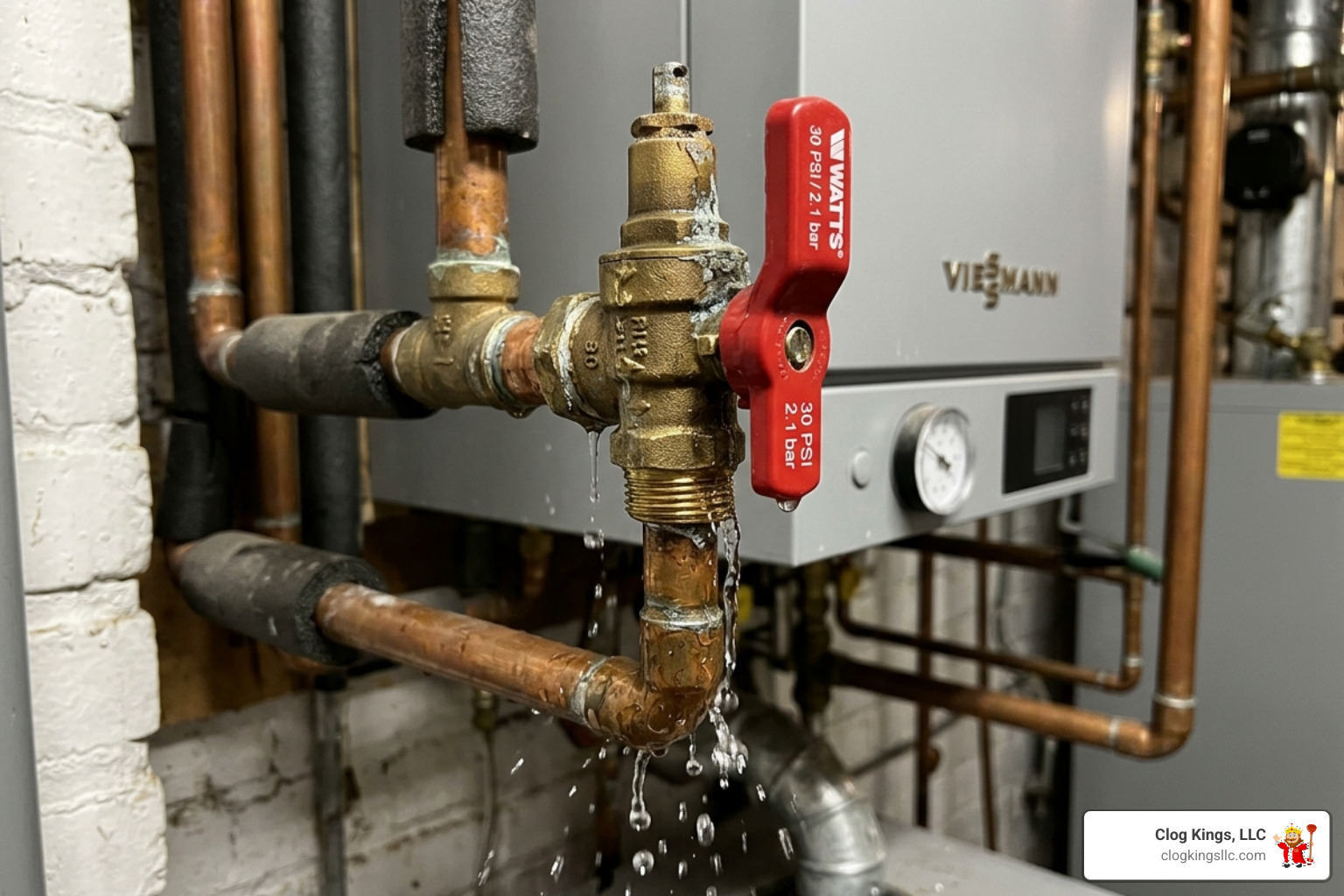
The most obvious sign is seeing water on the floor. Most residential boilers have a pressure relief valve set to 30 PSI. If your boiler pressure gauge climbs toward 30 PSI as the water heats up, and you see the relief valve dripping or spraying, your expansion tank is likely “toast.”
The Tapping Test
This is the simplest DIY diagnostic tool. Give the tank a few firm knocks with your knuckles or a screwdriver handle.
- Top of the tank (air side): Should sound hollow and metallic.
- Bottom of the tank (water side): Should sound duller or like a “thud.” If the entire tank sounds like a solid “thud” from top to bottom, it is waterlogged. This means the diaphragm has failed, and the air chamber is completely full of water.
The Schrader Valve Test
Most modern tanks have a small air valve (like on a bicycle tire) called a Schrader valve, usually hidden under a plastic cap.
- Depress the center pin of the valve briefly.
- If air comes out, the diaphragm might still be intact (though the pressure might just be low).
- If water squirts out, the diaphragm is definitely ruptured. You need to change expansion tank on boiler units immediately when water is present in the air chamber.
System Clanging and Banging
When the air cushion is gone, the system can experience “water hammer.” You might hear metallic clanging or knocking sounds as the circulator pump starts or as the water heats up. This is because the pressure spikes are vibrating the pipes against their hangers.
Step-by-Step Guide to Change Expansion Tank on Boiler Systems
If you’ve confirmed the tank is dead, it’s time to get to work. Replacing a tank usually takes about an hour or two, but it can save you hundreds in professional labor costs.
Tools and Materials Needed
- New expansion tank (sized correctly for your system)
- Pipe wrench or large adjustable wrench
- Teflon tape (PTFE tape) or pipe dope
- Tire pressure gauge
- Small air compressor or bicycle pump
- Bucket and towels (it’s going to get a little wet)
- A helper (optional, but helpful if the tank is heavy)
1. Safety First: Power and Water Shutoff
Never work on a hot boiler. Shut off the electrical power to the boiler at the breaker or the service switch. Close the water supply valve (the one feeding the boiler) to prevent the system from trying to auto-fill while you are working. If your system has isolation valves on the supply and return lines, close those too to minimize the amount of water you have to drain.
2. Draining the Pressure
You don’t need to drain the entire boiler, just the pressure. Attach a hose to the boiler drain valve or place a bucket under the pressure relief valve. Open the valve until the pressure gauge on the boiler reads 0 PSI.
Pro Tip: If your expansion tank is installed above the boiler, you only need to drain enough water to empty the pipe leading to the tank. However, if the tank is failed and waterlogged, be prepared—it will be heavy. A 4.4-gallon tank full of water weighs about 35 to 40 lbs.
3. Disconnecting the Old Tank
Use your pipe wrench to unscrew the old tank (counter-clockwise). If the tank is heavy, have your helper support it while you unscrew it. Caution: The water inside that tank might still be hot! Keep a bucket nearby to catch any residual water that spills from the pipe once the tank is removed.
4. Pre-charging the New Tank Before You Change Expansion Tank on Boiler
This is the most skipped step by DIYers, and it’s the most important. Most tanks come from the factory pre-charged to 12 or 20 PSI, but you must match it to your system’s static pressure.
- Check your boiler’s pressure gauge when the system is cold. For most two-story homes in the Pasco or Pinellas County areas, this is 12-15 PSI.
- Use a tire pressure gauge to check the new tank’s air valve.
- Use a pump or compressor to adjust the air pressure until it matches your cold system pressure (usually 12 PSI).
- If you need a high-quality replacement, many professionals recommend the Amazon: Amtrol ST-5 Expansion Tank for smaller systems or the Amtrol Extrol 30 for standard residential boilers.
5. Installation
Clean the threads on the pipe. Wrap the threads of the new tank with 3-4 layers of Teflon tape in a clockwise direction. Screw the new tank on by hand until snug, then give it an extra quarter-turn with the wrench. Do not overtighten, as you could crack the fittings.
6. Refilling and Bleeding Air After You Change Expansion Tank on Boiler
Now, we need to get the air out of the water side.
- Slowly open the water supply valve. You will hear water rushing into the tank and pipes.
- If you have a Spirovent or automatic air vent, it will start hissing as it lets air out.
- Check the pressure gauge. It should settle back at your cold fill pressure (12-15 PSI).
- Bleed the radiators: Go to the furthest radiator or baseboard and open the bleed valve until water comes out steadily. Repeat this for every radiator in the house.
- Check the boiler pressure again and add water if it dropped below 12 PSI.
7. Power Up and Test
Flip the power switch back on. Set your thermostat high enough to trigger the boiler to fire up. Watch the pressure gauge as the temperature rises. The pressure should only rise by a few PSI (e.g., from 12 PSI to 18 PSI). If it stays well below the 30 PSI limit, you have successfully completed the job!
Common Installation Mistakes to Avoid
Even though the process is straightforward, small errors can lead to big headaches. Here are the “don’ts” we’ve seen in the field across Hillsborough and Manatee Counties.
Using the Wrong Tank Type
There is a major difference between a “potable water” expansion tank (for water heaters) and a “hydronic” expansion tank (for boilers). Potable tanks are usually white and have internal linings for drinking water. Boiler tanks are often gray or blue and are designed for oxygen-free heating water. Using a water heater tank on a boiler can lead to premature corrosion.
Skipping the Pre-charge
If you install a tank with 20 PSI of air into a system that runs at 12 PSI, the tank won’t accept any water until the system hits 20 PSI. This effectively reduces the “working” size of your tank. Always match the air charge to the cold fill pressure.
Overtightening and Thread Damage
We often see DIYers crank down on the tank until the threads are stripped. Use Teflon tape and tighten firmly, but the rubber diaphragm inside is sensitive to extreme heat if you decide to solder nearby fittings later.
Undersizing the Tank
If your tank is too small, it won’t be able to handle the expansion of all the water in your system, especially if you have large cast-iron radiators.
| System Type | Recommended Tank Size | Common Model |
|---|---|---|
| Small Apartment / 1-2 Zones | 2.0 Gallons | Amtrol ST-5 |
| Standard 3-Bedroom Home | 4.4 Gallons | Extrol No. 30 |
| Large Home / Cast Iron Radiators | 7.6 – 11.0 Gallons | Extrol No. 60 or 90 |
The “Service Valve” Secret
If you want to make your life easier 5-10 years from now, install a service valve (also called a Webstone valve) between the pipe and the tank. This allows you to isolate and drain just the tank without losing any pressure in the boiler system. It makes the next time you change expansion tank on boiler units a 5-minute job with zero mess.
Frequently Asked Questions
How do I know if my expansion tank is waterlogged?
The most reliable way is the tapping test. A healthy tank will sound like an empty soda can on the top half. A waterlogged tank will sound like a solid piece of wood. Additionally, if you press the Schrader valve and water comes out, the tank is definitely waterlogged because the internal bladder has ruptured.
Can I use a water heater expansion tank on a boiler?
Technically, you can (the threads usually match), but you shouldn’t. Water heater tanks (potable) are built to handle higher pressures (up to 150 PSI) but often have different diaphragm materials. Boiler tanks are specifically designed for the chemicals and lower pressures (30-50 PSI max) found in heating systems. Stick to the gray or blue tanks labeled for hydronic use.
What is the standard pressure for a boiler expansion tank?
For most residential systems in Florida, the standard “cold” pressure is 12 PSI. You should never exceed the rating of your pressure relief valve, which is almost always 30 PSI. If your tank is charged to more than 25 PSI, it essentially becomes useless for a standard residential boiler.
Conclusion
Learning how to change expansion tank on boiler systems is a great way to protect your home’s heating infrastructure. By maintaining the correct pressure balance, you prevent leaks, reduce wear on your circulator pumps, and ensure your boiler runs efficiently during those surprisingly chilly Florida winters.
However, we know that working with pressurized boiler systems can be intimidating. If you find rusted fittings that won’t budge, or if your pressure relief valve continues to leak even after a tank replacement, it might be time to call in the experts.
At Clog Kings LLC, we provide 24/7 local service throughout Pasco, Manatee, Pinellas, and Hillsborough Counties. Whether you are in St. Petersburg, Tampa, or Largo, our team is ready to handle everything from simple tank swaps to complex boiler repairs and water heater services.
Don’t let a small tank issue turn into a flooded basement or a cracked boiler heat exchanger. If you’re in doubt, give us a call — we’re here to keep your system running smoothly without the mess!
