
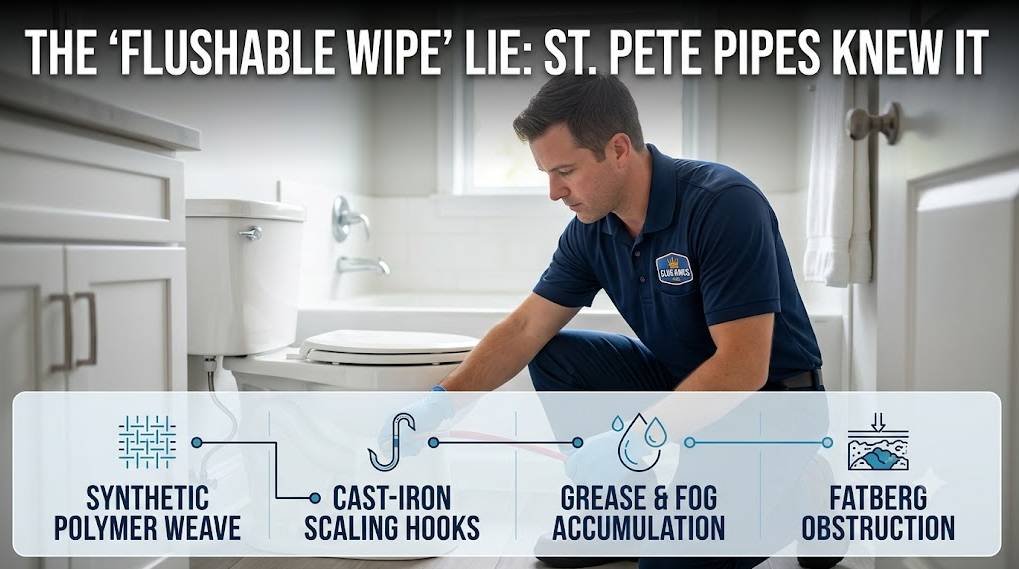

You reach for a package labeled “safe for sewer and septic systems,” wipe, toss it into the bowl, press the lever, and watch it swirl out of sight. It feels clean, convenient, and completely harmless.
However, beneath your tree-lined St. Petersburg driveway, deep within the subterranean sewer infrastructure connecting your home to the municipal main, a quiet mechanical disaster is unfolding.
The widespread marketing behind the flushable wipe lie has convinced millions of property owners across Pinellas, Pasco, Hillsborough, and Manatee Counties that pre-moistened wet wipes disperse in water just like standard bath tissue. The harsh physical reality facing local plumbing technicians every day tells a completely different story.
While paper towels and traditional bath tissue break apart into microscopic cellulose fibers within seconds of hitting water, synthetic wet wipes remain entirely intact. When these durable woven sheets enter your home’s main lateral line, they catch on internal scale, snag on tree root penetrations, combine with residual cooking fats, and create solid obstructions that back up raw sewage directly into your shower drains and toilets.
Why the Problem Is Worse Than It Looks
To understand why wipes wreak such havoc on private plumbing systems across St. Petersburg, you have to look at how subterranean wastewater infrastructure functions. Unlike pressurized municipal supply lines that force water into your home under high force, your main sewer lateral relies almost entirely on gravity and a very precise pipe slope to carry solid waste away.
When wet wipes enter this gravity-fed system, their synthetic construction prevents them from dissolving. Instead, they act as flexible drag nets inside your pipes.
The Anatomy of a Subterranean Sewer Blockage in St. Petersburg
Underground pipes across Pinellas County face environmental and structural stressors that turn single wiped flushes into total line collapses:
Cast-Iron Bottom Channeling: Thousands of classic homes throughout neighborhoods like Historic Kenwood, Crescent Lake, and Shore Acres feature original cast-iron sewer stacks. Over decades of service, acidic wastewater wears away the bottom of these pipes, creating a rough, jagged channel that snags synthetic wipe fibers instantly.
Fatberg Formation in Coastal Soils: When flushable wipes catch on an internal rough spot, they collect cooking oils, soaps, and grease poured down kitchen sinks. This mixture hardens into a concrete-like mass known as a fatberg, completely sealing off the pipe’s internal diameter.
Aggressive Coastal Root Systems: St. Petersburg’s warm climate and high water tables cause mature oak, palm, and pine roots to seek out moisture inside underground sewer joints. Once a fine root hair enters a pipe seam, passing wipes wrap around it like paper towels on a hook, creating a impenetrable structural clog.
⚠️ HOMEOWNER WARNING: The Chemical Drain Cleaner Trap
When shower drains start bubbling or toilets flush sluggishly due to wipe accumulation, many homeowners pour high-acid chemical drain cleaners down the hatch. This is a severe mistake. Chemical drain openers rely on liquid heat that cannot break down the synthetic plastic weaves used in modern wet wipes. Instead, the trapped caustic chemical sits idle inside your pipe, softening PVC glue joints or accelerating cast-iron oxidation, turning a standard blockage into a major failure requiring full sewer replacement.
Create a photorealistic cutaway/cross-section image, 16:9, showing a dense accumulation of synthetic wet wipes and congealed grease completely blocking an underground cast-iron sewer line beneath a St. Petersburg front yard. Show the subterranean pipe cross-section on one side and the ordinary-looking green lawn with a palm tree above ground on the other, photorealistic lighting and detail.

Integrated infographic overlay (semi-transparent panel, roughly one third of the frame, flat line-icon style, cool blue/white palette): 2–3 short labels with connector lines, reading exactly:
- "Non-Dispersed Wipe Mass"
- "Cast-Iron Corrosion Channel"
- "Restricted Wastewater Flow"

High detail, sharp focus, legible overlay text, no blur on labels. No competitor logos, no real identifiable people.
Alt text: "Flushable Wipe Lie — cross-section showing wet wipe sewer blockage in a Florida home"
The Professional Approach vs. DIY
Attempting to clear a deep wet-wipe blockage using a store-bought hand auger or a flexible rental snake rarely solves the problem. A standard wire cable simply punches a temporary hole through the wet-wipe mass. The moment you flush your toilet again, the surrounding mass closes back up, triggering another immediate overflow.
[Store-Bought Chemical/Auger] ──> Temporary Hole Punch ──> Wipe Mass Reseals ──> Home Sewage Flooding
[Master Diagnostic Protocol] ──> Digital Camera Survey ──> High-Pressure Jetting ──> Restored Full Pipe Radius
Resolving a wipe-choked sewer line requires engineering-grade equipment and step-by-step diagnostic accuracy. Before applying mechanical force, our field team conducts a detailed video plumbing inspection.
We launch a high-definition fiber-optic camera down your cleanout access point to pinpoint the exact location of the obstruction, evaluate the pipe’s physical structural integrity, and ensure no hidden root penetrations exist.
Once the obstruction is fully mapped, we avoid aggressive, pipe-damaging scraping by performing targeted drain cleaning procedures designed to scour internal pipe walls clean. Using high-pressure water streams, we shatter tough fatbergs, shred packed wipe masses, and flush all debris completely out into the city main.
“Marketing labels on consumer packaging do not override the laws of fluid dynamics and municipal engineering. If a product does not dissolve within seconds of water contact, flushing it down a private sewer lateral is an expensive gamble with your property value.”
Our field methodologies follow strict technical standards established by the International Association of Plumbing and Mechanical Officials, ensuring every line restoration project protects surrounding infrastructure and meets Florida building codes.
The Real Cost of Waiting
Ignoring sluggish drains, gurgling toilets, or sewer smells under the assumption that “the wipe will eventually dissolve” leads to sudden, catastrophic structural backups.
What starts as a minor $150 maintenance call can quickly escalate into a massive biohazard emergency involving flooded subfloors, ruined drywall, and denied insurance claims due to poor property maintenance.
The table below breaks down the financial progression of unaddressed wet wipe accumulation inside a residential plumbing line:
| Damage Progression Phase | Average Repair & Restoration Cost | Property Insurance Risk Profile | Projected Timeline to Total Failure |
Early Stage Slow floor drains, occasional toilet gurgling, or routine camera maintenance inspection. | $150 – $450 | Zero Risk: Standard flat-rate service call; zero property damage; full line flow restored. | Resolved immediately. |
Mid-Stage Recurrent line backups, chemical pour attempts, or localized fixture overflow. | $1,200 – $3,800 | High Risk: Active wastewater leaking under slab; potential mold growth; partial pipe displacement. | 1 to 3 Months |
Late-Stage Total main line collapse, structural sewage flooding, or foundation slab erosion. | $7,500 – $25,000+ | Critical Risk: High probability of claim denial; major structural restoration; loss of home use. | Immittent / Immediate |
If our camera inspection reveals that years of wipe accumulation and corrosion have fractured your main line beneath your foundation slab, executing a localized sewer repair seals the breach before foundation erosion occurs.
If your home’s older drainage lines exhibit structural decay from age and chemical exposure, arranging a comprehensive general plumbing repair ensures your entire drain stack handles daily household capacity smoothly.
“Unchecked sewer line backups do not stay confined to your pipes—they ruin subfloors, destroy cabinetry, and trigger thousands of dollars in unbudgeted biohazard remediation. Timely diagnostic intervention always costs a fraction of an emergency restoration bill.”
Create a photorealistic image, 16:9, of a plumbing technician reviewing video inspection footage on a tablet next to a sewer cleanout in a driveway. Bright, modern Florida home setting, natural light, commercial-photography quality.

Integrated infographic overlay (semi-transparent panel, roughly one third of the frame, flat line-icon style, cool blue/white palette, one accent color): a simple 3-stage escalation graphic mirroring the post's cost table, labeled exactly:
- "Early: $150 – $450"
- "Mid-Stage: $1,200 – $3,800"
- "Late-Stage: $7,500 – $25,000+"

High detail, sharp focus, legible overlay text and numbers, no blur. No competitor logos, no real identifiable people.
Alt text: "Flushable Wipe Lie cost comparison — early vs. late-stage repair"
Why Clog Kings
Clog Kings LLC is dedicated to protecting homes and commercial properties throughout Pinellas, Pasco, Hillsborough, and Manatee Counties from preventable plumbing disasters. We are fully licensed, bonded, and insured, maintaining active corporate registration with the Florida Department of Business and Professional Regulation.
Our team brings over a decade of hands-on local field experience to every call. We know the specific soil conditions, tree species, and historical piping materials unique to St. Petersburg and surrounding Tampa Bay communities.
We operate with strict financial integrity, providing upfront flat-rate pricing so you never face hidden fees or surprise emergency charges. To support those who have served and built our local communities, we offer dedicated senior and military veteran discounts across all our plumbing services.
Whether you need a quick toilet repair after a toddler drops a non-flushable object down the trap, or a complex main line overhaul, our technicians complete the work right the first time.
Recently, a family living near Old Northeast St. Pete experienced repeating main line backups every time their washing machine drained. A previous general contractor had claimed the entire yard needed to be excavated. Our technicians performed a detailed camera survey, located a dense, localized mass of baby wipes lodged in a single pipe fitting, cleared the obstruction in under two hours, and saved the homeowner thousands of dollars in unnecessary digging.
What to Expect When You Call Us
We take the stress out of plumbing emergencies through a transparent, 4-phase client experience:
Phase 1: Rapid Local Dispatch: Our team logs your call, gathers critical details about your fixture symptoms, and dispatches a fully stocked service vehicle directly to your property.
Phase 2: Master Diagnostic Inspection: Our technicians evaluate your fixture flow, check static line pressures, and insert specialized digital cameras down your main cleanout to locate blockages precisely.
Phase 3: Clear Digital Briefing: We walk you through live video footage of your pipe’s interior, explain the exact nature of the obstruction, and provide straightforward flat-rate options. If an aging water heater is also showing signs of sediment buildup, we can outline a simple water heater replacement plan to improve utility efficiency.
Phase 4: Precision Execution & Flow Verification: We execute the authorized service, perform rigorous flow testing across all household fixtures, clean up our workspace completely, and provide digital records for your home files.
Quick Answers: Frequently Asked Questions
How long does drain cleaning take?
A standard professional drain cleaning service typically takes 1 to 2 hours to complete. If the line contains severe calcified grease, dense tree root intrusion, or requires an extensive high-definition video camera inspection, the process can take between 2 and 4 hours.
Can wipes labeled “flushable” really cause sewer backups?
Yes. Products labeled “flushable” pass short-term manufacturing tests because they clear the toilet bowl, but they do not break down in water like standard toilet paper. As they travel through private lateral lines, they catch on pipe joints, accumulate grease, and cause severe subterranean backups.
How do I know if my sewer line is blocked by wipes or tree roots?
Single slow drains usually indicate a localized fixture clog, but if flushing a toilet causes water to back up into your shower, or if multiple ground-floor drains gurgle simultaneously, your main sewer line is obstructed. A professional camera inspection is the only definitive way to distinguish between wet wipe accumulation, root intrusion, or structural pipe failure.
How does hard mineral water affect pipe drainage speed?
Florida’s municipal water supplies carry high concentrations of dissolved minerals like calcium and magnesium. Over time, these minerals form internal scale ridges that slow down drainage and snag passing waste materials. Installing a professional water softener installation filters out hard minerals before they enter your supply lines, protecting fixtures and appliances from premature wear.
For total peace of mind regarding household water quality, adding a whole-home water filtration system removes residual chlorine, unpleasant odors, and fine sediment from every tap in your house.
The Fix Starts with a Call
Your plumbing system is the most overlooked infrastructure in your home. Until it fails.
Don’t let the flushable wipe lie compromise your property’s drainage, cause expensive structural backups, or damage your home equity. Investing in a professional diagnostic line inspection gives you clear visual proof of your system’s health, restores proper drain speeds, and keeps your waste flowing smoothly toward the city main.
While protecting your subterranean pipes, consider upgrading your home’s hot water performance with a compact tankless water heater installation. Tankless units deliver on-demand hot water while meeting rigorous efficiency criteria managed by EPA WaterSense.
Take proactive control of your home’s plumbing health today:
Request Your Evaluation: Get Your Free Estimate from Clog Kings by visiting our secure digital portal and booking a comprehensive line assessment.
24/7 Emergency Dispatch: If raw sewage is actively backing up into your fixtures or overflowing onto floors, call us immediately at 727-479-4028 for immediate priority technician routing.
Explore Full-Home Options: Review our high-efficiency water treatment and water heating upgrades to safeguard your home’s total infrastructure value.
We serve homeowners across St. Petersburg and the greater Tampa Bay area with 24/7 emergency dispatch, upfront pricing, and master-level diagnostic integrity. Contact our team today!
