
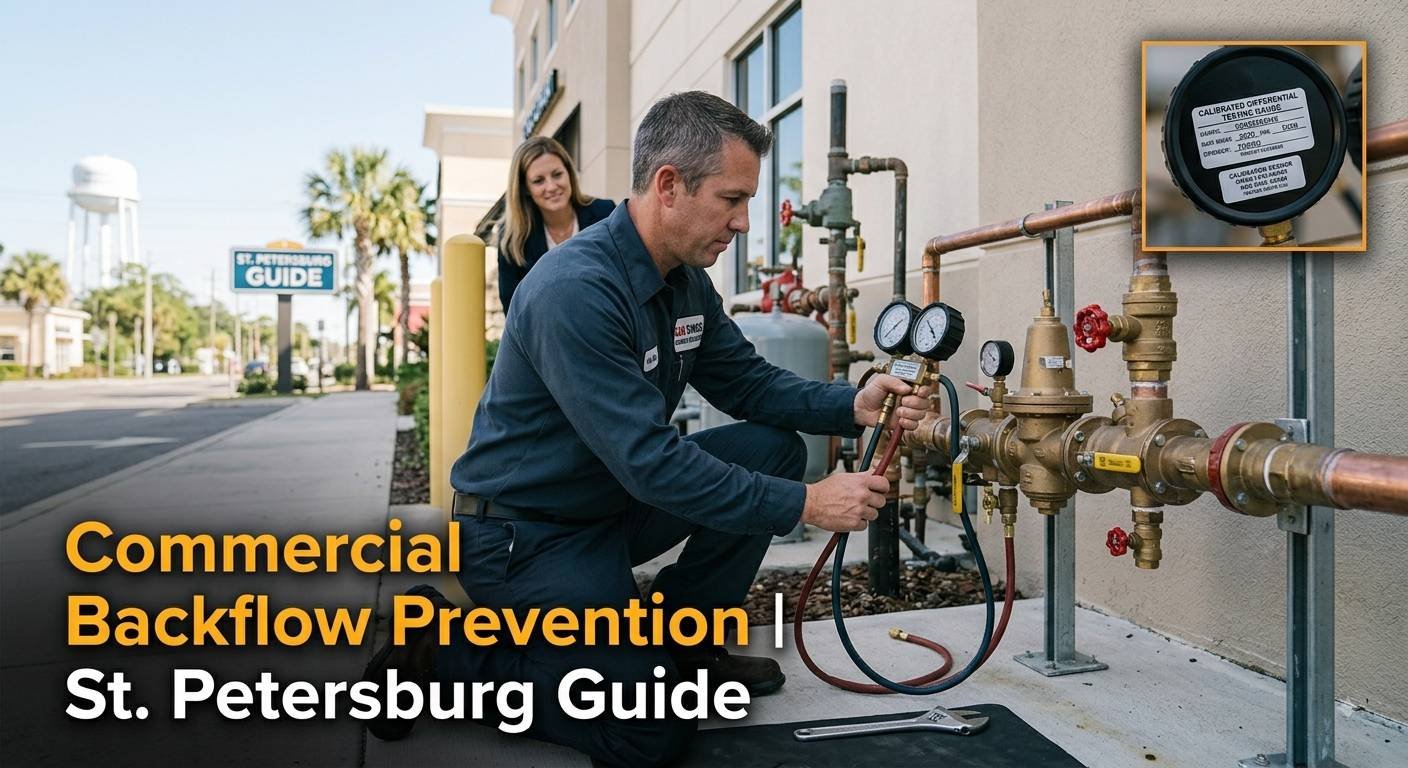

The Problem Behind the Problem
For commercial property owners and facility managers across St. Petersburg—from industrial parks in Gateway and high-density retail spaces in Downtown St. Pete to dining hubs along Grand Central—maintaining clean, safe municipal water is a strict legal requirement. Yet, one of the most vital mechanical safeguards on your property remains invisible until a compliance notice arrives or a cross-connection emergency occurs.
Plumbing systems rely on directional pressure to keep clean supply water moving forward into your building. However, when municipal water main pressure drops unexpectedly—or when downstream equipment creates higher mechanical pressure—the direction of flow reverses. This condition, known as backflow, pulls contaminated water directly into the city’s potable drinking supply.The Problem Behind the Problem
For commercial property owners and facility managers across St. Petersburg—from industrial parks in Gateway and high-density retail spaces in Downtown St. Pete to dining hubs along Grand Central—maintaining clean, safe municipal water is a strict legal requirement. Yet, one of the most vital mechanical safeguards on your property remains invisible until a compliance notice arrives or a cross-connection emergency occurs.
Plumbing systems rely on directional pressure to keep clean supply water moving forward into your building. However, when municipal water main pressure drops unexpectedly—or when downstream equipment creates higher mechanical pressure—the direction of flow reverses. This condition, known as backflow, pulls contaminated water directly into the city’s potable drinking supply.
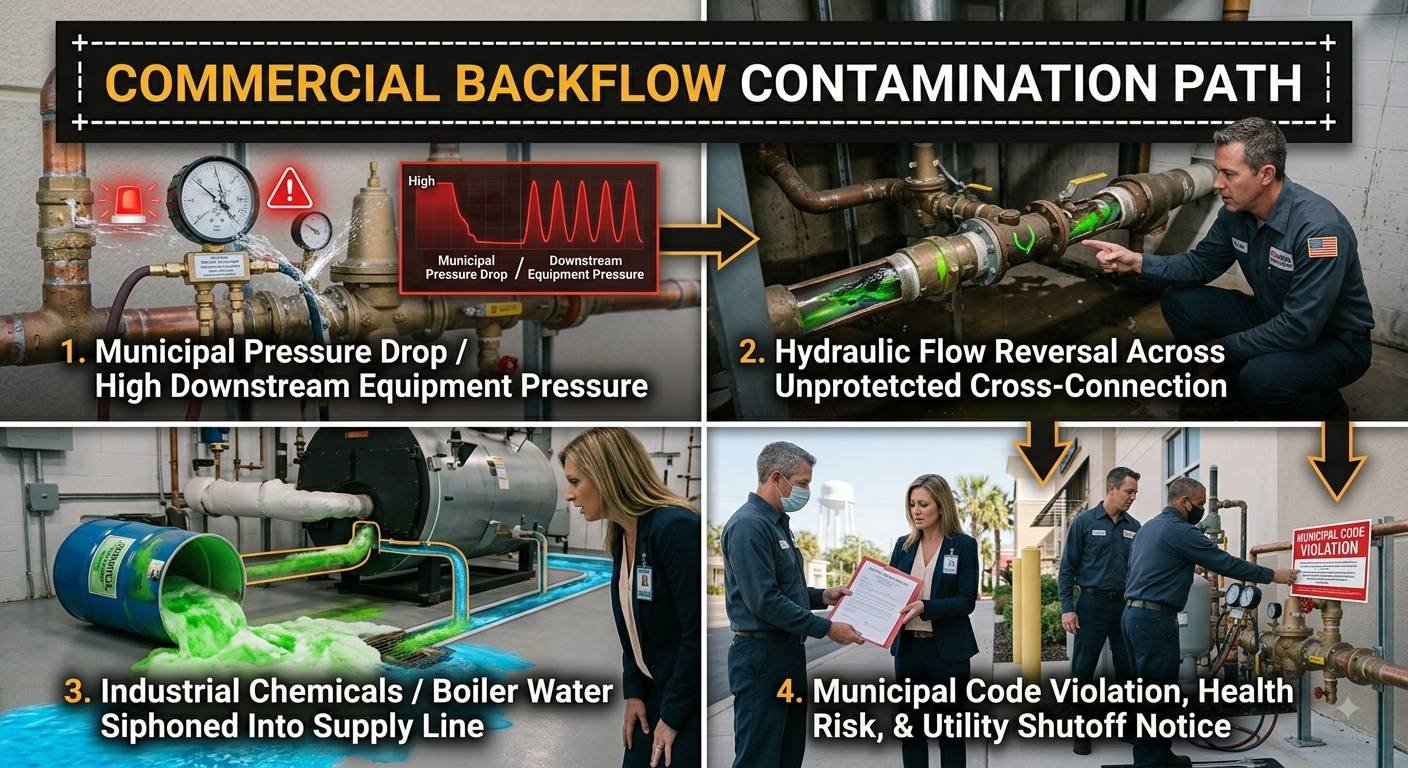
St. Petersburg’s unique commercial footprint presents significant hydraulic stress. Waterfront developments, commercial irrigation networks, industrial boilers, and soda fountain lines all represent potential cross-connections. Without a functioning, certified backflow preventer, a routine water main break three blocks away can transform your facility’s internal wastewater into a community health hazard.
Why the Problem Is Worse Than It Looks
In commercial properties, backflow risks fall into two distinct mechanical categories: backsiphonage (caused by a sudden drop in municipal line pressure) and backpressure (caused by downstream pumps, boilers, or elevated storage tanks exceeding incoming city pressure).
Because backflow prevention assemblies contain delicate internal check valves, heavy-duty springs, and rubber relief seats, normal mechanical wear causes these components to degrade over time.
![A side-by-side technical comparison diagram of a commercial Reduced Pressure Zone (RPZ) backflow assembly, titled "COMMERCIAL BACKFLOW ASSEMBLY: INTACT VS. DEGRADED".The left panel, labeled "[CERTIFIED COMPLIANT RPZ]" with a green checkmark, illustrates a clean, properly functioning blue RPZ valve assembly with arrows showing normal water flow. Text annotations point to the "First Check Valve (Opens at >2 PSI)", "Differential Pressure Relief Valve (Active)", and "Clean Internal Seals". Below the diagram, green bullet points highlight key features: First Check Opens at >2 PSI, Differential Relief Active, Annual Testing Verified, and Zero Contamination Risk.The right panel, labeled "[DEGRADED / FAILING ASSEMBLY]" with a red X and warning icons, shows a corroded, rusted valve assembly with brown contaminated water flow. Text annotations point to "Fouled Rubber Seals & Scale Buildup", "Stuck Relief Port Valve", "Obstructed Check Valve", and "Contaminated Backflow Route". Below the diagram, red bullet points outline the risks: Fouled Rubber Seals / Scale, Stuck Relief Port Valve, Unnoticed Cross-Siphonage, and Impending Utility Shutoff.](https://clogkingsllc.com/wp-content/uploads/2026/08/Gemini_Generated_Image_l3ihzel3ihzel3ih.jpg)
3 Primary Causes of Commercial Backflow Failures in St. Petersburg
- [Mineral Incrustation & Debris Fouling]: Hard water minerals and sediment from municipal supply lines settle on check valve seats, preventing internal flappers from sealing tightly during pressure changes.
- [Backsiphonage Spikes from Utility Events]: High-volume water pulls—such as municipal fire hydrant activation or nearby main repairs—create sudden negative pressure zones that force uncertified valves to fail.
- [Thermal & Mechanical Fatigue]: Commercial boiler loops, expansion tanks, and pressure booster pumps place continuous strain on internal backflow spring assemblies, leading to fatigue and pressure relief bypass leaks.
COMMERCIAL PROPERTY WARNING: Utility Shutoff & Liability Risk
Commercial backflow prevention assemblies are monitored closely by environmental compliance authorities. Ignoring annual testing notices or allowing an unqualified contractor to attempt uncertified repairs can trigger immediate water service disconnection and severe municipal fines.
The Hidden Cost of Non-Compliance
A failed or uncertified backflow assembly puts your entire business operation at risk. Beyond the threat of drinking water contamination, a forced water shutoff by local utility inspectors leads to immediate operational downtime, lost revenue, emergency commercial repair fees, and potential civil liability.
The Professional Approach vs. DIY
Testing, repairing, and certifying commercial backflow assemblies requires specialized diagnostic equipment, calibrated differential pressure gauges, and precise mechanical expertise.
- [Precision Differential Pressure Testing]: Attaching NIST-calibrated pressure testing gauges to test cocks to measure exact pressure drops across internal check valves.
- [Internal Component Rebuilding]: Disassembling the housing to clean mineral deposits, replace worn rubber discs, and install OEM spring assemblies.
- [Hydrostatic Pressure Verification]: Re-pressurizing the unit to confirm relief valve opening thresholds and verify zero internal bypass leakage.
- [Municipal Compliance Reporting]: Submitting certified test results directly to regional backflow management portals to keep your business fully compliant.
“Commercial backflow testing isn’t just an administrative check-box—it is an essential engineering safeguard that protects public health and keeps St. Petersburg businesses running without interruption.”
The Real Cost of Waiting
Proactive annual testing and prompt assembly rebuilding prevent costly emergency shutoffs and extensive mechanical failures.
Backflow Compliance Cost & Risk Matrix
| Compliance Strategy | Average Direct Cost | Water Service Risk | Business Interruption Risk |
| Annual Certified Testing & Maintenance | $150 – $350 | Zero Risk | None (Scheduled Service) |
| Deferred Repair Following Test Failure | $450 – $1,200 | Moderate (30-Day Warning) | Low if Resolved Promptly |
| Ignored Notices / Utility Disconnection | $3,000 – $10,000+ | Severe (Immediate Disconnect) | High (Total Business Downtime) |
Why Clog Kings
- State Licensed, Bonded, and Insured: Fully compliant with Florida DBPR requirements under State Master Plumber License #CFC1429816.
- Certified Backflow Technicians: Highly trained in testing and servicing Reduced Pressure Zone (RPZ), Double Check Valve (DCVA), and Pressure Vacuum Breaker (PVB) assemblies.
- Upfront Commercial Pricing: Transparent testing and rebuild rates with no hidden fees.
- Regional Coverage: Serving St. Petersburg, Pinellas County, Pasco, Hillsborough, and Manatee Counties.
- Senior, Veteran, and Commercial Partner Discounts
What to Expect When You Call Us
Phase 1: Rapid Commercial Scheduling
We schedule your backflow test during low-impact operational hours to prevent any inconvenience to your customers or staff.
Phase 2: On-Site Differential Pressure Testing
Our certified technician hooks up calibrated testing gauges to verify relief port cracking pressure and check valve tightness.
Phase 3: Immediate Precision Rebuilding (If Needed)
If the assembly fails test parameters, we carry common commercial rebuild kits on our mobile units to restore full mechanical function immediately.
Phase 4: Official Compliance Documentation
We log and submit your passing test results directly to municipal environmental tracking portals, providing you with a digital copy for your property records.
Client Success Case: Grand Central District Restaurant
- Issue: A popular commercial kitchen in St. Petersburg received a 30-day utility notice for an overdue RPZ backflow re-certification.
- Solution: Clog Kings dispatched a certified backflow specialist, identified a fouled check valve seat, rebuilt the internal assembly with OEM seals, and re-tested the unit.
- Result: Passed certification on the spot, test results were filed same-day, and the business avoided a forced utility shutoff.
The Fix Starts with a Call
- Schedule Your Inspection Online: Visit Clog Kings LLC Service Scheduling.
- Call Our Direct Hotline: Speak directly to a certified backflow specialist at (727) 479-4028.
- Explore Commercial Services: Learn more about our Annual Backflow Testing, Commercial Plumbing Solutions, and Commercial Drain Cleaning.
About the Author & Local Details
Clog Kings LLC is a leading commercial and residential plumbing contractor based in St. Petersburg, Florida. Operating under Florida State Plumbing License #CFC1429816 and verified through the Florida DBPR, Clog Kings provides certified backflow prevention testing, RPZ repairs, commercial repiping, and 24/7 emergency services across Gateway, Downtown St. Pete, Grand Central, Tyrone, and all surrounding Pinellas County commercial corridors.
- Corporate Office: St. Petersburg, FL | Serving All St. Pete Commercial Zones
- Direct Phone: (727) 479-4028
- State License: #CFC1429816 (Florida DBPR)
- Hours: 24/7 Emergency Commercial Service Available
