

Your Clay Sewer Pipe Is Cracking — Here’s What You Need to Know
Clay sewer pipe repair is something thousands of Florida homeowners face every year — especially in older homes built before the 1970s.
Quick answer: How do you repair a clay sewer pipe?
| Method | Best For | Invasiveness | Lifespan Added |
|---|---|---|---|
| Epoxy putty / spot patch | Single small crack | Low (minimal digging) | A few years |
| Rubber boot coupling (Fernco) | Cracked joint or hub end | Low (small excavation) | 10–20+ years |
| CIPP pipe lining | Cracks, root gaps, joint leaks | Very low (trenchless) | 50+ years |
| Pipe bursting | Severely damaged or collapsed line | Low (two access points) | 50+ years |
| Full excavation & replacement | Total collapse, major offsets | High | 50–100 years |
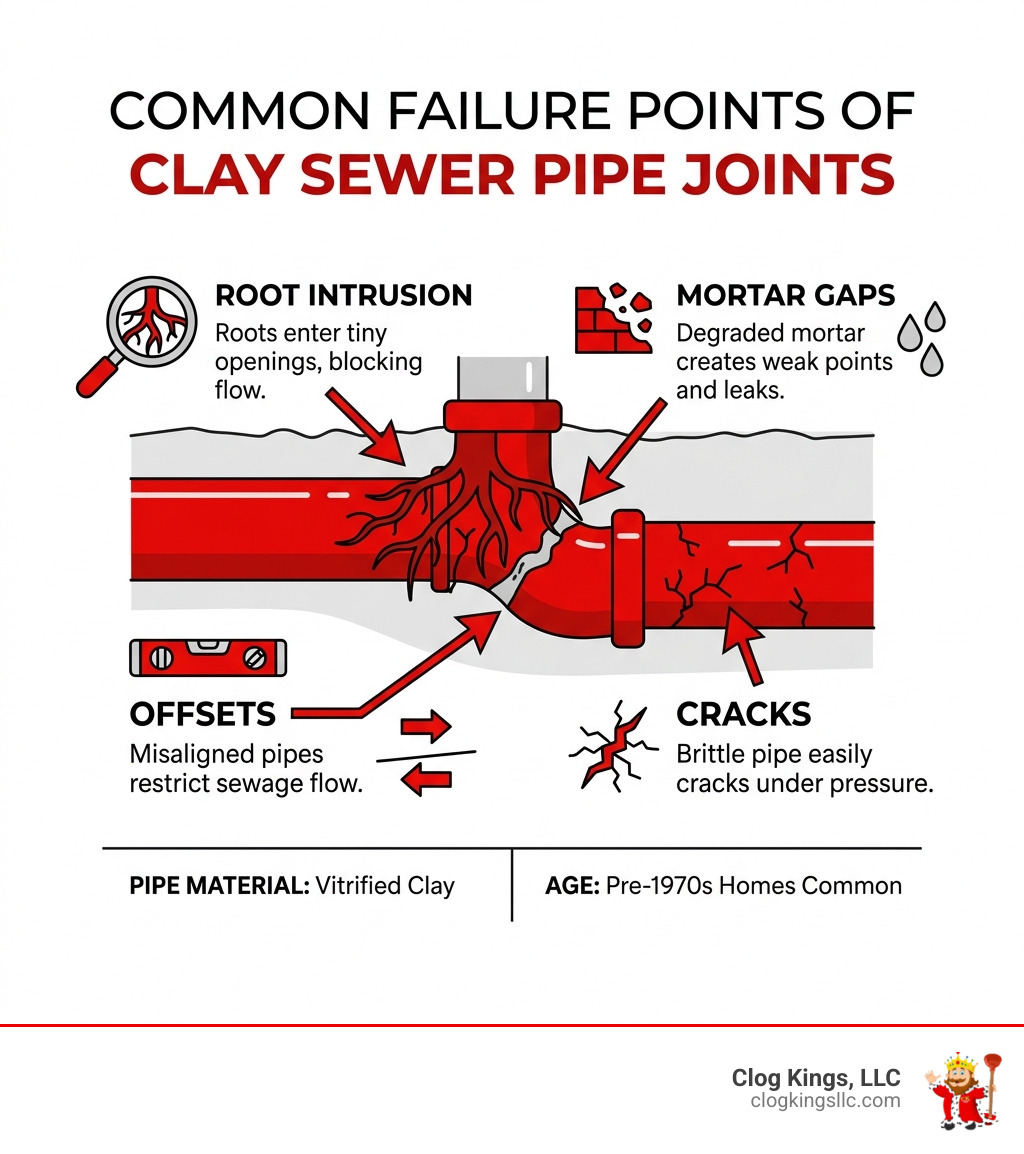
Clay pipes are brittle. They crack at the joints. Tree roots find their way inside through tiny mortar gaps. And once one section starts failing, others usually follow.
The tough part? Most of the damage is hidden underground — which means you often don’t know how bad things are until you’re dealing with a sewage backup or a soggy patch of lawn that won’t dry out.
One homeowner described the situation well in an online forum: he had a 1940s clay sewer line where the female end of a single segment cracked from root infiltration — and suddenly he was weighing the cost of digging up his yard against the price of a trenchless lining job. That’s a decision a lot of Florida homeowners are facing right now.
I’m Joey Denick, and with over 20 years of hands-on experience in clay sewer pipe repair and sewer line diagnostics, I’ve seen every failure type these old pipes can throw at you. In this guide, I’ll walk you through exactly what’s going on with your pipe and how to fix it — for good.
Understanding Clay Sewer Pipes: History and Lifespan
If you live in an older neighborhood in Tampa, St. Petersburg, or Clearwater, there is a very high chance your home relies on Vitrified Clay Pipe (VCP). These pipes, often referred to as terracotta, have been used for centuries. In fact, some clay drainage systems date back to ancient Rome! In the United States, they were the standard for residential sewer laterals from the early 1900s through the late 1960s.
The Anatomy of a Clay Pipe
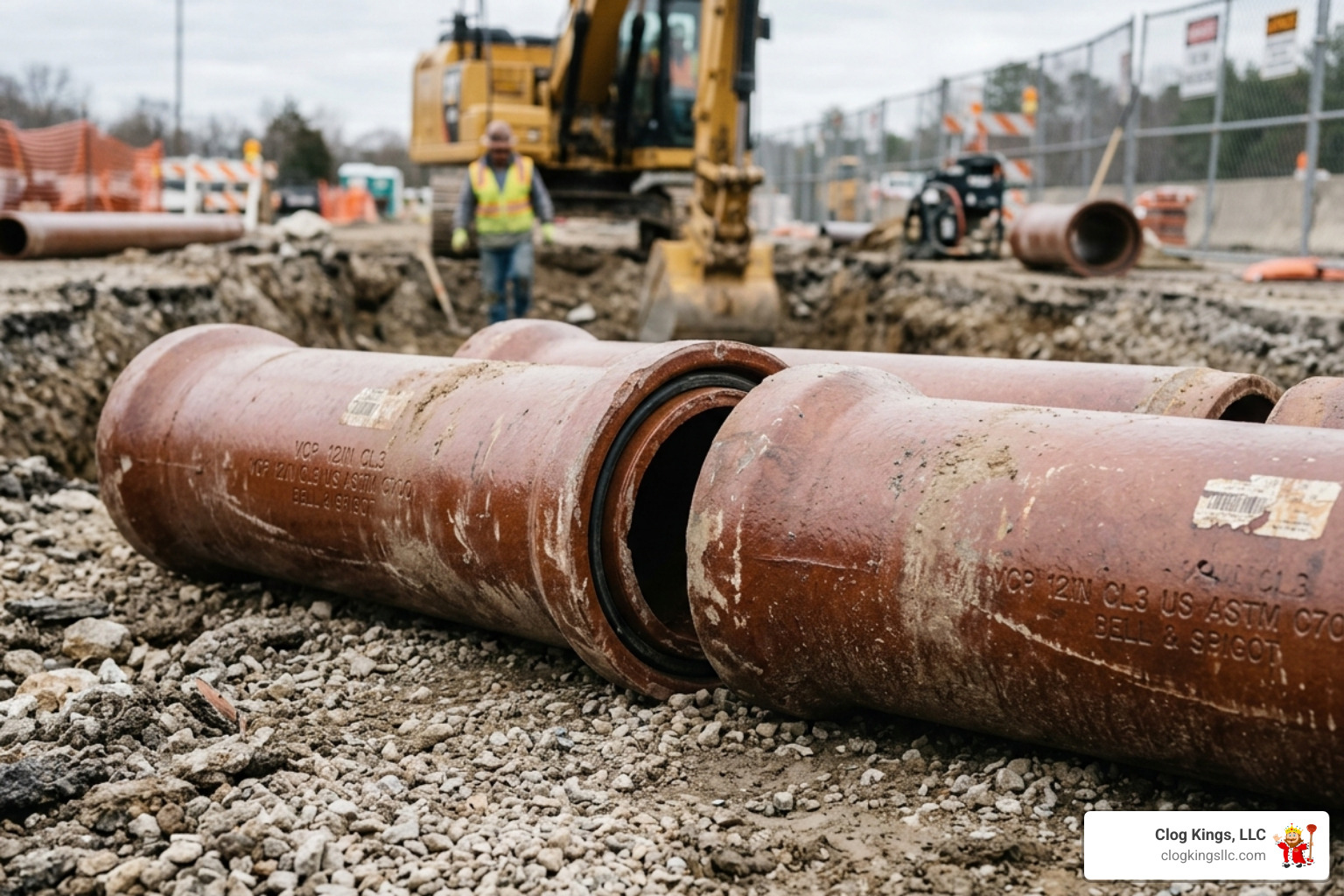
Clay pipes were typically manufactured in short segments, usually 3-foot or 4-foot lengths. They use a “bell-and-spigot” design, where the narrow end of one pipe (the spigot) fits into the flared end of the next (the bell or hub). In the old days, these joints were sealed with mortar, tar, or even oakum.
While clay is incredibly resistant to chemical corrosion and sewer gases, it has one major weakness: low tensile strength. This means that while it can handle the weight of the earth pressing down on it, it cannot handle movement.
How Long Do They Really Last?
On average, clay sewer pipes last 50 to 60 years. However, in the shifting, sandy soils of Pasco and Pinellas Counties, that lifespan can fluctuate. Ground shifting, heavy vehicle traffic overhead, or even the natural wet-dry cycles of Florida weather can cause these brittle pipes to crack or the joints to separate.
When the joints separate, they create tiny gaps. To a thirsty tree root, those gaps are an invitation to a never-ending water source. Once a root enters, it expands, eventually shattering the pipe from the inside out. If you’re wondering about the rest of your home’s infrastructure, check out our guide on What’s the Lifespan of My Home’s Plumbing? to see how clay stacks up against modern materials.
Professional Solutions for clay sewer pipe repair
Before you grab a shovel, we need to know exactly what we’re dealing with. At Clog Kings LLC, we don’t guess—we inspect. Dealing with a cracked clay sewer pipe requires a precise diagnosis because a “spot repair” on one section might be useless if the rest of the line is already filled with roots.
Warning Signs You Can’t Ignore
If you notice any of the following, your clay pipes are likely crying out for help:
- Sewage Backups: If your lowest drains (like a shower or basement floor drain) are backing up, the main line is obstructed.
- Gurgling Noises: That “glug-glug” sound from the toilet when you run the sink is air trapped by a blockage.
- Lush, Green Patches: Is one part of your lawn suspiciously greener than the rest? It might be getting “fertilized” by a leaking sewer pipe.
- Sewer Gas Odors: You should never smell rotten eggs in your yard or bathroom. A smell indicates a break in the line.
The first step in any professional clay sewer pipe repair is a Video Inspection of Sewer Lines. We run a high-definition waterproof camera through the line to find the exact location of cracks, offsets, or root clusters. This saves you thousands of dollars in unnecessary digging.
Trenchless Technology for clay sewer pipe repair
In the past, fixing a sewer meant digging a massive trench through your driveway or rose garden. Today, we use trenchless technology to fix the pipe from the inside out.
Cured-In-Place Pipe (CIPP) Lining
This is often called “no-dig” repair. We pull a flexible, epoxy-saturated felt liner through the existing clay pipe. Once in place, we inflate it and let it cure (harden). The result is a seamless, jointless “pipe-within-a-pipe” that is actually stronger than the original clay.
- Benefit: It seals all those pesky joints where roots enter.
- Lifespan: Adds 50+ years of service life.
- Learn more: All About Trenchless Pipe Lining.
Pipe Bursting
If the clay pipe is too collapsed for a liner, we use pipe bursting. We pull a heavy-duty “bursting head” through the old pipe, which shatters the clay and pushes it into the surrounding soil. Simultaneously, it pulls a brand-new HDPE (high-density polyethylene) pipe into place. This gives you a brand-new line with only two small access holes.
Step-by-Step DIY clay sewer pipe repair
We’ll be honest: DIY sewer repair is a messy, difficult job that often requires permits. However, if you have a shallow, accessible pipe with a single localized crack, a “spot repair” is possible.
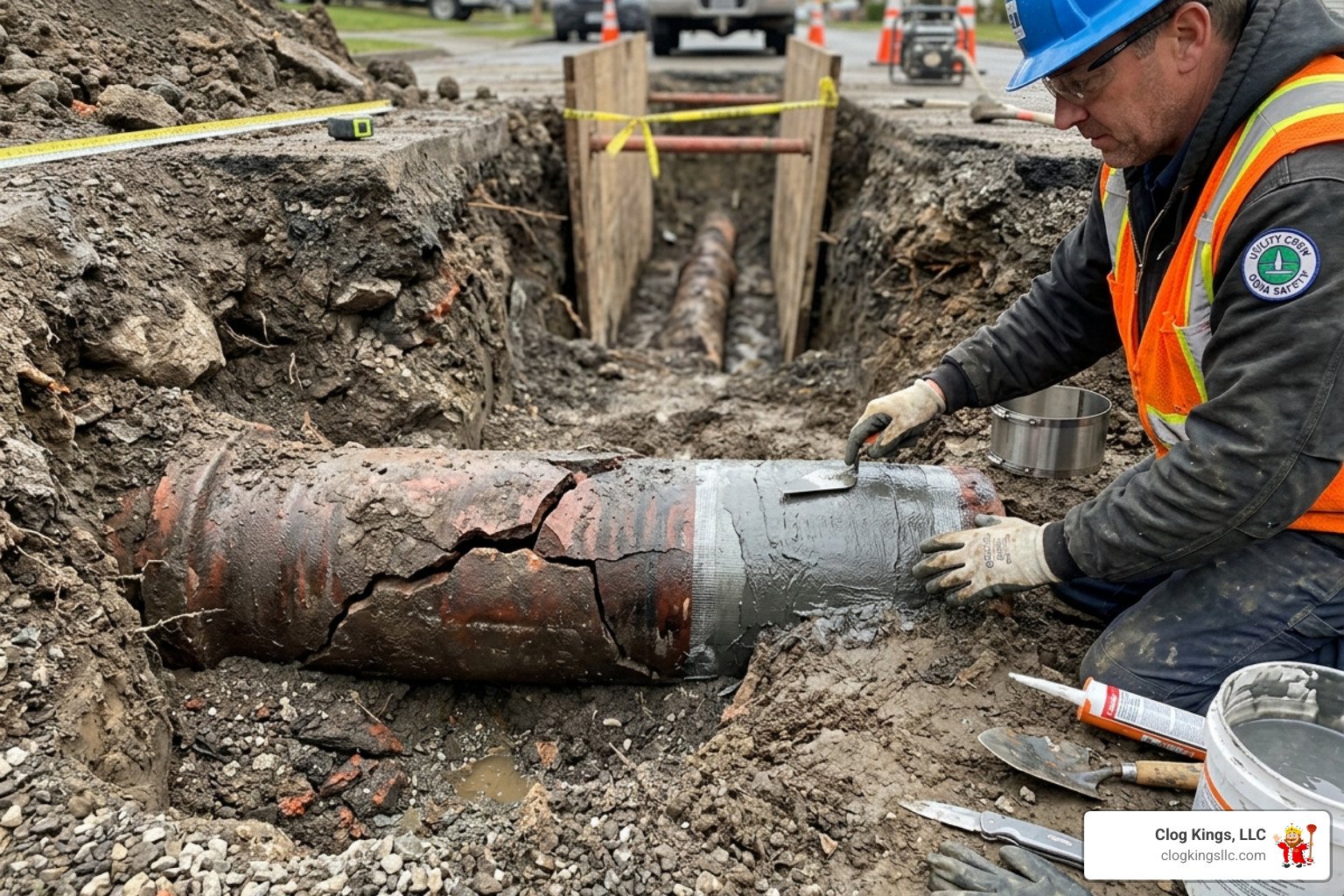
- Locate and Excavate: Use the camera footage to find the exact spot. Dig carefully; clay is fragile and you don’t want to break more of it.
- Clean the Area: Use an air compressor or a stiff brush to remove dirt from the exterior of the pipe.
- The Abrasive Cut: If a section needs to be removed, use an abrasive cutoff wheel for a clean cut. Do not use a hammer—it will shatter the pipe.
- Rubber Boot Couplings: Use a rubber coupling (often called a Fernco). These have stainless steel bands that tighten around the clay on one side and a new piece of PVC on the other.
- Seal with Epoxy Putty: For tiny pinholes or hairline cracks, specialized plumbing epoxy putty can be applied to the exterior. It’s a temporary fix, but it can stop a leak for a few seasons.
- Backfill: Once the repair is tested for leaks, backfill with sand or fine gravel to provide a stable bed for the pipe.
Comparing Trenchless vs. Traditional Replacement Methods
Choosing between trenchless and traditional digging is usually a matter of “total cost” vs. “sticker price.” While a trenchless liner might seem more expensive upfront, the “hidden costs” of traditional digging—like replacing a concrete driveway or re-sodding a yard—can quickly bridge the gap.
| Factor | Trenchless (CIPP/Bursting) | Traditional Excavation |
|---|---|---|
| Average Cost | $125 – $250 per foot | $50 – $150 per foot |
| Restoration Cost | Minimal | High (Landscaping, Driveways) |
| Project Time | 1 – 2 Days | 5 – 7 Days |
| Durability | 50+ Years (HDPE/Epoxy) | 50-100 Years (PVC) |
| Root Resistance | High (Seamless) | Moderate (Has Joints) |
In January 2023, a typical 68-foot sewer lining project cost approximately $8,800. While that sounds high, consider that traditional digging might have required $5,000 in landscape and driveway repairs on top of the plumbing bill. When you factor in the 30–50% savings on restoration, trenchless is often the smarter financial move. If you’re looking at a full home overhaul, you might also want to research How Much Will It Cost to Repipe a House? to plan your budget effectively.
Frequently Asked Questions
Can you repair just one section of a clay pipe?
Yes, this is known as a “spot repair.” It works best when the damage is localized to one area (like a single cracked segment) and the rest of the pipe is in good structural shape. We excavate the damaged section, cut it out, and replace it with PVC using rubber transition couplings. However, if the camera shows roots at every joint, a spot repair is just a band-aid.
How do tree roots get into clay sewer lines?
Clay pipe joints were originally sealed with mortar or tar, which degrades over 50 years. As the ground shifts, tiny hairline gaps open up. Tree roots can sense the moisture and nutrients inside the pipe. They grow into these gaps, and as the root thickens, it acts like a slow-motion wedge, splitting the clay bell or hub. This leads to “scaling” (debris catching on roots) and eventual total blockage.
Is pipe relining better than full replacement?
“Better” depends on your property. Pipe relining (CIPP) is the gold standard for clay sewer pipe repair because it creates a seamless, jointless barrier that roots cannot penetrate. It is non-invasive and preserves your yard. However, if the pipe has completely collapsed or “bellied” (sagged), relining won’t work because the liner follows the shape of the existing pipe. In those cases, pipe bursting or traditional replacement is necessary.
Conclusion
Living with old clay pipes doesn’t have to be a ticking time bomb. Whether you need a simple spot repair with a rubber coupling or a full-scale trenchless restoration, the key is acting before a small crack becomes a flooded yard.
At Clog Kings LLC, we specialize in helping homeowners across Pasco, Manatee, Pinellas, and Hillsborough Counties navigate the complexities of clay sewer pipe repair. From St. Petersburg to Tampa, our team is available 24/7 for emergency services. We’ll start with a professional video inspection to show you exactly what’s happening underground, so you can make an informed decision for your home.
Don’t wait for the next heavy Florida rain to turn your yard into a swamp. Schedule your expert Sewer Repair today and get your plumbing back from “cracked” to “intact.”
