
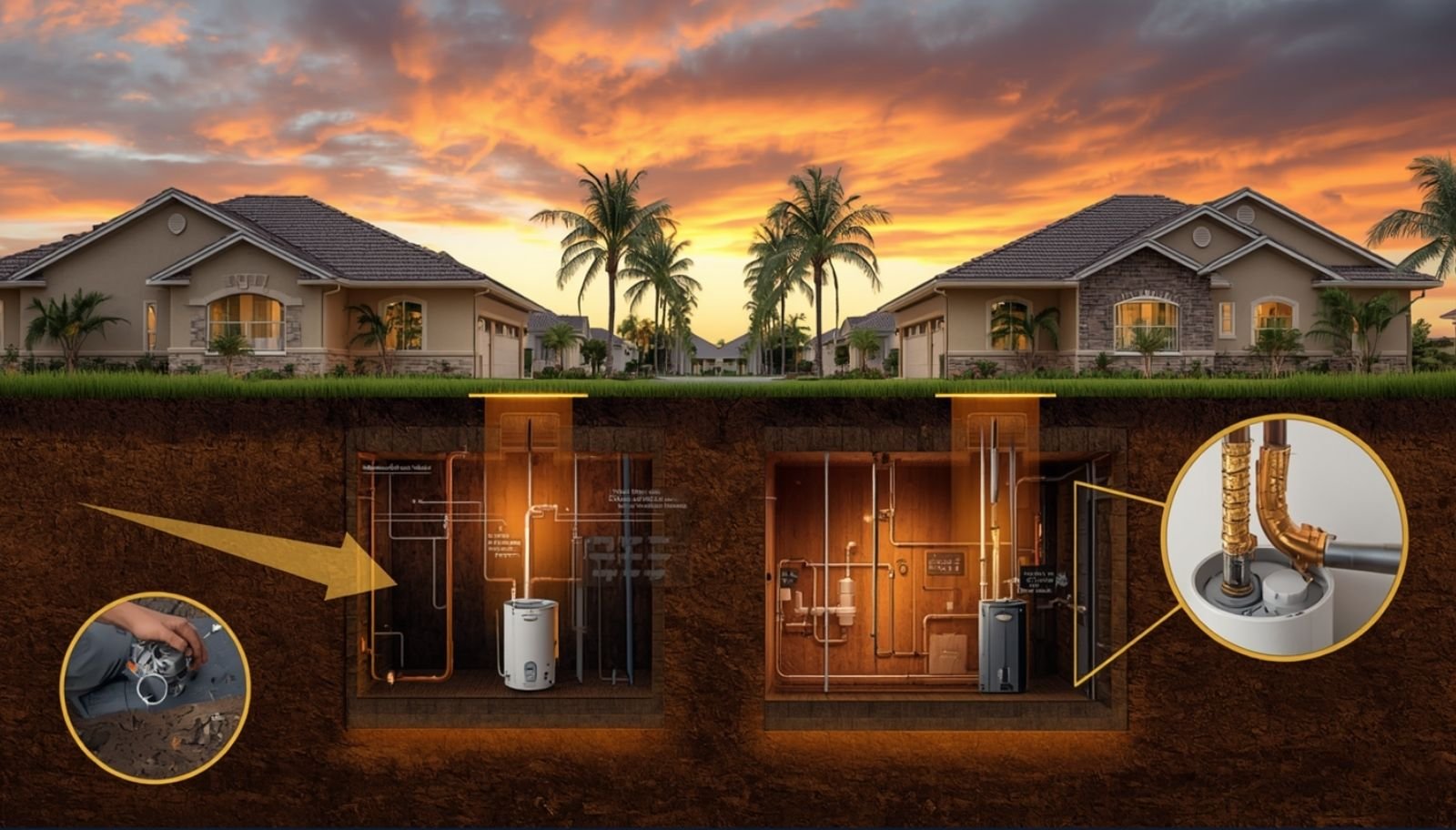

The Problem Behind the Problem
Imagine preparing for your morning commute in Wesley Chapel or cooking dinner for your family in Hudson, only for the shower to turn ice-cold mid-lather because the dishwasher started running downstairs. For thousands of homeowners across Pasco County, the daily frustration of running out of hot water is an all-too-common irritation. However, the real issue isn’t just a sudden burst of cold air—it’s the invisible financial drain hidden inside your utility closet.
Most residential properties throughout Florida are outfitted with standard, traditional storage tank water heaters. These systems operate on a continuous loop, constantly firing up to reheat 40 to 50 gallons of water all day and night, regardless of whether you’re at work, sleeping, or away for the weekend. This phenomenon is known as standby heat loss, and it acts as a direct tax on your household budget.
As utility rates continue to climb across the state, continuing to sink capital into an outdated, inefficient plumbing system becomes a costly mistake. Evaluating a water heater replacement isn’t just about avoiding a cold shower; it’s about optimizing your home infrastructure for long-term operational return on investment (ROI).
Why the Problem Is Worse Than It Looks
Leaving an aging, inefficient tank system in your home does more than inflate your monthly power bills. It triggers an ongoing cycle of structural degradation that severely compromises your entire home’s piping distribution layout. The root cause behind this systemic failure comes down to local geology: Pasco County’s municipal water supply contains heavy concentrations of dissolved minerals like calcium and magnesium.
When water is held at high temperatures inside a standard steel storage tank, these minerals precipitate out of solution and form a hard, crusty barrier along the bottom of the tank liner and around the heating elements. In the plumbing industry, we refer to this phenomenon as The Calcified Blanket Effect.
[Hard Ground Water Enters Tank] ➔ [Sustained High Thermal Exposure] ➔ [Mineral Precipitation] ➔ [Calcified Scale Layer Formed] ➔ [Thermal Transfer Blocked]
This thick layer of sediment acts as an insulator between the burner or heating elements and the water inside the tank. As a result, the system must run longer and hotter just to achieve basic target temperatures, subjecting the tank steel to intense, localized Thermal Stress. Over time, this stress fractures the internal glass lining, leading to structural micro-cracks, accelerated corrosion, and an inevitable tank rupture that can flood your garage or home interior.
The Professional Approach vs. DIY
When faced with an underperforming water heater, many homeowners resort to temporary retail remedies, such as installing a sacrificial anode rod from a big-box store or turning up the thermostat dial. Unfortunately, these surface-level modifications fail to address the underlying structural sediment blockages or the system’s inherent design flaws.
The professional approach to managing residential hot water distribution demands advanced field diagnostic methodologies. Before performing any water heater replacement, field service technicians should run a comprehensive pipeline diagnostic assessment. Utilizing an industrial-grade video plumbing inspection, teams can look inside your structural piping to assess current scale levels, identify pressure drops, and check for structural deterioration.
If heavy sediment has already traveled out of your old tank and into your main water lines, simple component replacements won’t fix your home’s water pressure issues. In these scenarios, complete system remediation requires professional drain cleaning and targeted hydro jetting drain cleaning across connected discharge assemblies to safely flush out hardened mineral blockages without compromising the integrity of your pipeline joints.
When replacing the old system altogether, switching to a high-efficiency tankless water heater installation completely eliminates the risk of standby tank failure because there is no storage reservoir to collect sediment or corrode.
The Real Cost of Waiting
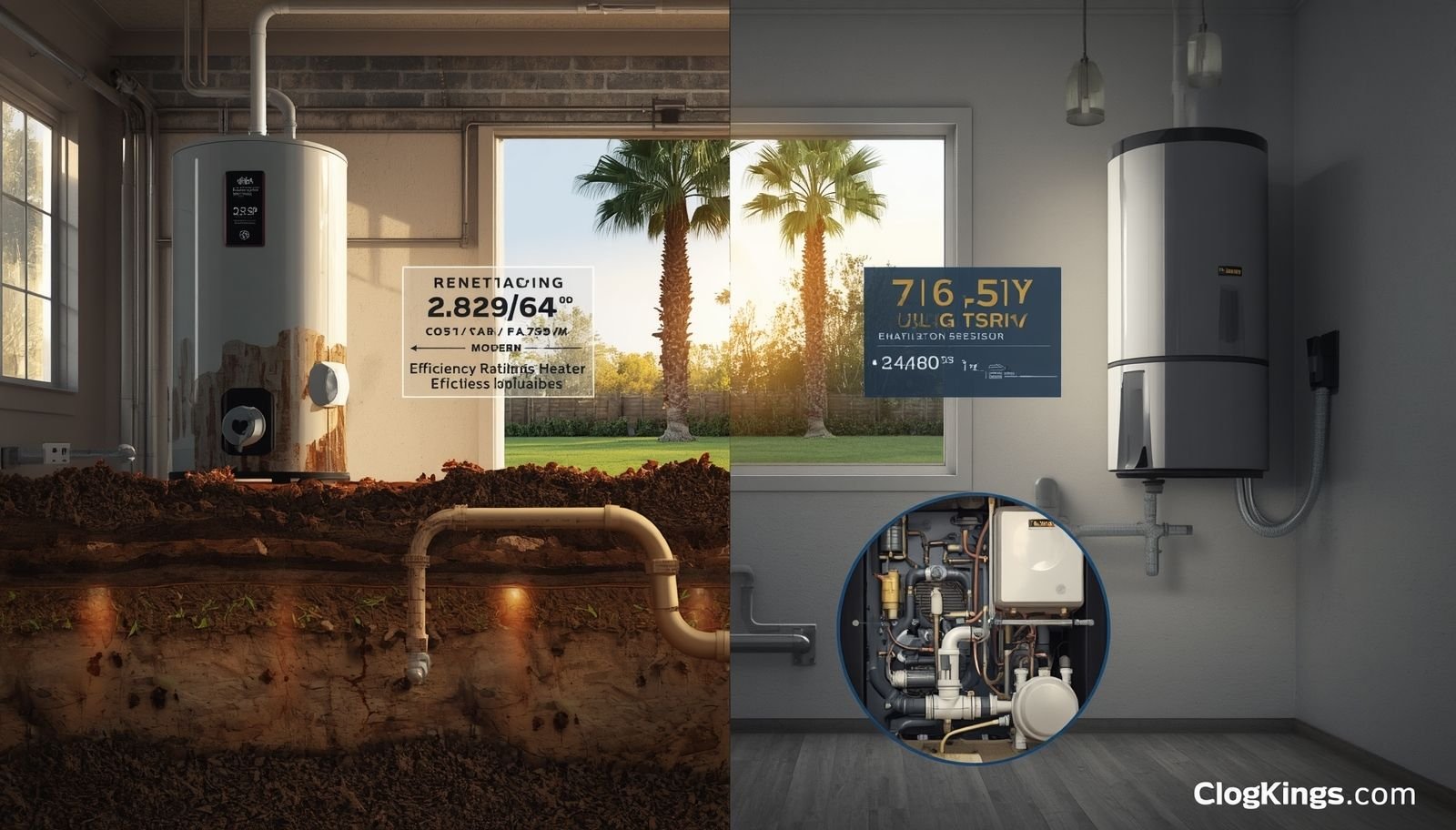
Postponing an infrastructure upgrade can be costly when you evaluate the compounded operational expenses of maintaining an aging storage tank over time. The following tables outline the clear economic differences between traditional storage models and advanced condensing tankless systems over a multi-year timeline.
Initial Asset Investment & Core Specifications
| Engineering Metrics | Standard Electric Storage Tank (50-Gal) | Condensing Gas/Electric Tankless System |
| Average Equipment Lifecycle | 8 to 11 Years | 20+ Years (Field Verified) |
| Energy Factor Rating (UEF) | 0.90 to 0.93 UEF | 0.95 to 0.99 UEF |
| Standby Thermal Loss Factor | High (Continuous Cycle) | Absolute Zero |
| Installation Footprint Size | 20 to 24 sq. ft. of floor space | Zero floor space (Wall-Mounted) |
Multi-Year Operational Cost Projections (Family of 4)
| Cost Category Over Time | Traditional Tank Upgrade | Advanced Tankless System |
| Upfront Purchase & Baseline Setup | $1,400 – $2,200 | $3,500 – $5,200 |
| Annual Estimated Energy Expense | $580 / year | $190 / year |
| Targeted Maintenance Requirements | $0 – $150 (Flushes often ignored) | $150 / year (Required scale flush) |
| Accumulated 5-Year Energy Cost | $2,900 | $950 |
| Accumulated 10-Year Energy Cost | $5,800 | $1,900 |
| Total Estimated 10-Year Asset Cost | $7,200 – $8,000 | $5,400 – $7,100 |
While a traditional storage tank keeps your upfront equipment acquisition costs low, it results in substantially higher operational costs over its functional lifetime. Over a ten-year operational window, the reduced energy use of an on-demand tankless system offsets its higher initial cost, delivering a clear net financial return to the homeowner.
Why Clog Kings
Upgrading your home’s hot water system requires precise execution by licensed professionals to ensure code compliance, proper ventilation, and valid manufacturer warranties. Clog Kings LLC delivers certified plumbing solutions engineered specifically to handle the unique regional challenges of Florida’s Gulf Coast infrastructure.
Regulatory & Code Compliance: All field technicians operate under strict state licensing protocols, maintaining active registration with the Florida Department of Business and Professional Regulation (DBPR).
Comprehensive Insurance Protection: Our operations are backed by comprehensive general liability and property damage insurance shields, protecting your real estate asset during complex installations.
Transparent Financial Structure: We use a flat-rate, transparent pricing matrix. The amount detailed on your project assessment is the exact amount you pay—with no hidden line items or surprise change orders.
Regional Service Reach: Our fleet provides rapid response coverage across Pinellas, Pasco, Hillsborough, and Manatee counties, keeping fully stocked service vehicles nearby to quickly handle any residential plumbing emergency.
What to Expect When You Call Us
We minimize residential disruption by steering every service call through a rigorous, multi-tiered project management sequence. This ensures clear transparency from your initial consultation to the final quality sign-off.
[Phase 1: Diagnostic Assessment] ➔ [Phase 2: Infrastructure Prep] ➔ [Phase 3: System Calibration] ➔ [Phase 4: Flow Validation]
Phase 1: Diagnostic Assessment: Technicians run full digital water quality and pressure assessments to verify that your electrical service panels or fuel supply configurations can support the new high-efficiency system.
Phase 2: Infrastructure Preparation: The old tank asset is safely drained, uninstalled, and extracted from your home for eco-friendly regional disposal, following local environmental management protocols.
Phase 3: Structural System Calibration: The team mounts the compact tankless unit, integrates dedicated sediment filters, and configures precision digital temperature limits.
Phase 4: Flow Validation: We run comprehensive performance verifications across all household plumbing fixtures to ensure stable pressure delivery and rapid hot water activation.
Infrastructure Success Summary
A family of five living in Trinity, FL, recently reached out to us regarding a failing 50-gallon electric storage tank that was causing high electricity bills and frequent arguments over short showers. Our team carried out a complete water heater replacement, installing a high-efficiency condensing tankless system integrated with a dedicated scale-inhibitor filter line.
Following the upgrade, the family completely eliminated their hot water shortages. Additionally, verified utility bill audits over the next six months showed an average reduction of 32% in their monthly water-heating energy costs, putting the system on track for a full financial break-even well before year six.
The Fix Starts with a Call
Continuing to operate an aging, sediment-packed hot water tank is an unnecessary financial drain on your household budget. Transitioning to a modern, on-demand tankless configuration protects your home from flooding risks, stabilizes your monthly utility expenses, and guarantees an endless supply of hot water for your family.
All Clog Kings installations are completed in strict compliance with the International Association of Plumbing and Mechanical Officials (IAPMO) structural code parameters and align with EPA WaterSense performance guidelines to maximize eco-friendly home efficiency.
Don’t wait for a costly tank rupture to force your hand. Contact our local service desk today to schedule your system evaluation.
Direct Dispatch Line: 727-479-4028
Online Booking Target: Get Your Free Estimate from Clog Kings
